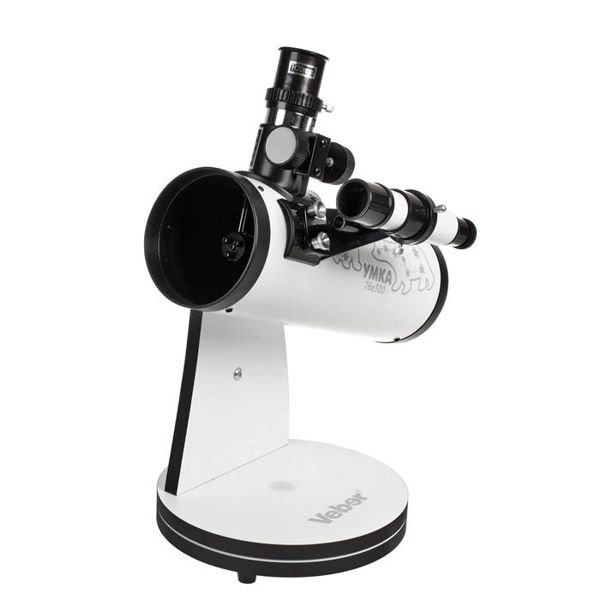
Telescope Veber Umka 76x300
The Veber Umka telescope is far from a toy, and not a simple decoration for a child’s room - it is, first of all, a real telescope. Its body is made of high-quality materials, and looking at its design, memories of childhood arise in your head, of a cartoon where a brave bear cub met a boy and they became friends... Northern lights, Arctic haze and the majestic constellations of Ursa Major and Ursa Minor. The stars are like distant beacons illuminating the path for future space travelers... The Universe will become even closer to you, just look at it through a telescope. And then she, perhaps, will reveal her secrets to you too. The Veber Umka 76/300 telescope is a classic Newtonian reflector on a turret-type alt-azimuth mount (Dobsonian mount). With such small dimensions (tube length 300 mm, 76 mm diameter) it may seem that this is a children's telescope, but look into it and your opinion will change dramatically. High-quality manufacturing and reliable design of the telescope will allow you to easily and in detail examine any stars and objects of the solar system. Moreover, with a 15x magnification (H20 mm eyepiece), you can focus on any objects during the day. This telescope can also be used as a tabletop spotting scope. The telescope kit includes two eyepieces (8 mm and 20 mm) and a 2x Barlow lens, thanks to which you can change the magnification ratio by simply replacing the eyepieces. High-quality manufacturing of the mount, all focusing units and optical elements, allows you to easily and in detail examine many stars and objects of the solar system. Well, for observing the Moon, the telescope comes with a special lunar filter. It will reduce the unwanted brightness of reflected light from our natural satellite. With such a filter, the clarity of the image will remain unchanged, and the natural color of the Moon will remain the same, in addition, this filter is also suitable for observing “double” stars. Installing eyepieces An eyepiece is an optical element that magnifies the image produced by a telescope. The eyepiece is inserted into the focusing unit tube, from which the plug must first be removed. The screws should not go deep into the focusing tube. Insert the chrome part of the eyepiece into the focusing tube and tighten the screws. You should start searching for an object using the telescope's viewfinder. After pointing the viewfinder at the object, install a low power eyepiece (15x) and focus with it. The magnification can then be increased to 37.5x by replacing the eyepiece as described above. If you install a Barlow lens between the eyepiece and the focusing tube, the magnification of the telescope will increase exactly 2 times. Pointing the telescope Place the telescope on a table or other stable support with a level surface. The telescope rotates easily in any direction. Loosen the clamping screw (turn it counterclockwise) and hold the back of the pipe. Looking along the telescope tube through the viewfinder, aim it at the object of interest by moving the back of the tube, and placing the object in the field of view, tighten the locking screw. Image orientation When viewing through an eyepiece from the back or side of the telescope tube, the image in the eyepiece will be upside down or at an angle. Focus This is done by turning the focus knob. After changing eyepieces, you need to refocus. Moon sighting The best time to observe the details of the moon's relief is not the full moon, but its partial phases (around the first and last quarter). For comfortable observation, you should use a lunar filter. Planetary observation The bright planets - Venus, Mars, Jupiter, Saturn - are fascinating objects to observe. To observe planets, you need to know their position in the starry sky at a given moment in time. Observing deep space objects To search for these objects (galaxies, nebulae and star clusters), it is convenient to use guide stars, moving the telescope from star to star in the direction of the search object. Surveillance of ground objects Simply point the telescope at the object of interest and focus. Eyepieces and magnification The telescope comes with two different eyepieces - 20 mm (15x magnification) and 8 mm (37.5x magnification). When installing a Barlow lens, the magnification of the telescope increases by 2 times.
- Telescope type: Reflector
- Optical design: Newton
- Lens diameter (aperture), mm: 76
- Focal length, mm: 300
- Maximum useful magnification, x: 152
- Magnification, x: 8 mm (37.5x), 20 mm (15x)
- Aperture, f: 3.9
- Eyepieces included: Yes
- Mounting diameter of eyepieces, inches: 1.25
- Barlow lens included: 2x
- Finder: Optical 5x24
- Tripod: Aluminum
- Control type: Manual
- Mount type: Dobsonian
- Filters included: Lunar
- User level: For children, For beginners
- Country: China
- Warranty: 1 year
- Weight: 1.9 kg