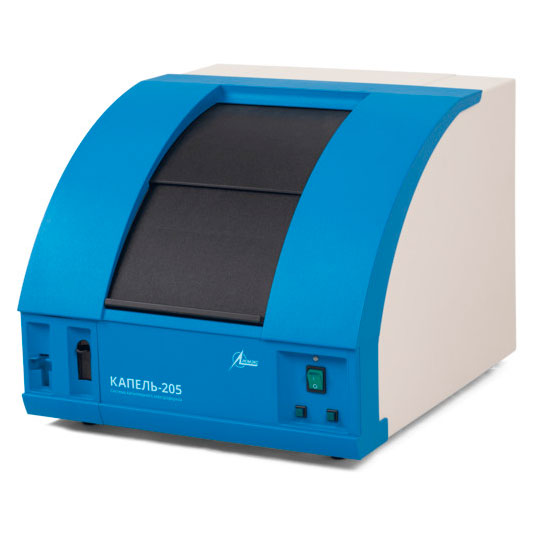
Capillary electrophoresis system Kapel-205
Capillary electrophoresis system Kapel-205 designed for quantitative and qualitative determination of the composition of samples in aqueous and aqueous-organic solutions. This is the most modern model in the line and a convenient tool for solving research and routine analytical problems. The Kapel-205 system is equipped with a photometric detector with switchable wavelength, an automatic sample changer system with increased capacity, a water cooling system for the capillary and automatically switchable polarity. The principle of operation is based on the separation of the components of a dissolved sample in a quartz capillary under the influence of an electric field and the recording of output signals corresponding to each component. A deuterium lamp is used as a light source, and a diffraction monochromator with a spectral range of 190-380 nm is used as a dispersing element. This range allows you to select the detection wavelength that is most sensitive to the target components. You can record the absorption spectra of the components of the analyzed sample. Autosampler with increased capacity of 59 positions for disposable Eppendorf tubes (1.5 ml). Sample injection methods: hydrodynamic (at pressure from −100 to 100 mbar), electrokinetic (at voltage from −30 to +30 kV). The unique design of the system for automatically opening the tubes immediately before use completely eliminates evaporation and protects solutions from contamination. The new high-voltage monoblock provides automatic polarity change and reaches 30 kV. Capillary cooling is liquid. Distilled water is used as a coolant. Setting and control of the coolant temperature is possible in the range from a temperature 10 degrees below ambient temperature to 50 °C. Capillary flushing is automatic (at constant pressure from 500 mbar to 2000 mbar). It allows you to work with highly viscous background electrolytes in capillary gel electrophoresis mode. All procedures, from sample injection to capillary rinsing, are performed automatically in programming mode, which reduces time and the likelihood of errors during analysis, improving the reproducibility of results. Application of the Kapel-205 system: Analysis of environmental objects: natural, drinking, waste water (inorganic cations and anions, herbicides); soils, grounds, bottom sediments (water-soluble forms of inorganic cations and anions). Control of the quality, authenticity and safety of drinks (organic acids, acids (including individual forms of D- and L-isomers), sugars, inorganic cations and anions, vitamins, amino acids, preservatives, sweeteners, synthetic dyes, furfurals, aromatic aldehydes, amines, pesticides). Control of the quality and safety of food products, food raw materials and dietary supplements (preservatives, sweeteners, caffeine, theobromine, organic acids, sugars, anions, amino acids, amines, proteins). Veterinary medicine and quality control of feed and feed raw materials (amino acids, vitamins, organic acids, inorganic cations and anions, antibiotics, coccidiostatics). Pharmaceutical industry (safety and quality control of synthetic substances, natural raw materials, active pharmaceutical ingredients, excipients and finished drugs, including analysis of protein drugs by capillary gel electrophoresis and capillary isoelectric focusing). Forensic examination. Clinical biochemistry (ions, amino acids, amines, peptides in biofluids). Chemical industry. Basic package: Kapel-205 system. specialized software Elforan. 2 cassettes with capillary. system testing kit. Eppendorf tubes. reusable filter attachment, filters. By additional order: kits for determination (the kit for determination includes: the text of the method, standard samples, reagents for background electrolytes and auxiliary solutions, specialized glassware, etc.). Set for determination of cations (NH4, K, Na, Mg, Ca) in mineral, organomineral and organic fertilizers. Set for determination of anions (chloride, nitrate, sulfate, fluoride, phosphate) in mineral, organomineral and organic fertilizers. Kit for determination of amide nitrogen (urea, urea) in fertilizers. Kit for determination of boron in fertilizers. Kit for the determination of chlorites, chlorates, perchlorates in drinking water, including those packaged in containers. additional cassettes with capillary. microdispensers for 10-100, 100-1000 µl, 1-5 ml and tips for them. Quantification Capabilities Components Measuring range Drinking, natural and waste water, mg/l Cations: ammonium, sodium, potassium, calcium 0.5…5000 lithium 0.015…2.0 magnesium 0.25…2500 strontium 0.25…50 barium... 0.1…10 Anions: nitrites 0.2…100 nitrates 0.2…500 sulfates, chlorides 0.5…20 000 fluorides 0.1…25 phosphates 0.25…100 Perchlorates (drinking water) 0.5…50 Chlorates 0.5…200 Chlorites 0.2…50 Acetic acid (acetates) (natural and wastewater) 0.01…10000 Bromides 0.05…100 Iodides (drinking, natural, mineral waters) 0.1…100 Herbicides of the phenoxycarboxylic acid class: 2,4-D, 2,4-DP, 2,4-DM, FUK 0.002…0.2 Phenoxycarboxylic acid class herbicides: 2,4-D (drinking water) 0.003…0.1 Soils, mg/kg Anions (water-soluble forms): acetates 3.0…1000 nitrates 3.0…10000 oxalates 3.0…100 sulfates, chlorides 3.0…20000 formates 1.0…500 phosphates 3.0…5000 fluorides 1.0…100 Cations (water soluble forms): ammonium, potassium, sodium 2.0…20000 calcium 2.0…10000 magnesium 1.0…10000 Fertilizers, % Cations (water-soluble forms, total content): ammonium (ammonium nitrogen) 0.01…35 potassium (potassium oxide) 0.01…55 magnesium (magnesium oxide) 0.01…25 sodium (sodium oxide), calcium (calcium oxide) 0.01…40 Anions (water-soluble, digestible forms, total content): chlorides 0.01…40 sulfates (sulfur, sulfur oxide (VI) 0.01…75 nitrates (nitrate nitrogen) 0.01…80 fluorides 0.01…3 phosphates (phosphorus, phosphorus oxide V) 0.01…85 Urea (amide nitrogen N…NH2) 1…100 (0.47…47) Food products, food raw materials, dietary supplements Sugars: glucose, fructose, lactose, sucrose 0.2…100% Sugars: glucose, fructose, lactose, sucrose (dairy products for baby food) 0.5…10% Phosphates (milk) 5…1500 mg/l Caffeine and theobromine 0.01…10% Preservatives and sweeteners: benzoic, sorbic acids and their salts, acesulfame K, saccharin 20…10000 mg/kg Glutamic acid and its salts (E620-E625): (food products) 1……100 g/kg (food additives) 2.5…100% Guanylic and inosinic acids and their salts: (food products, food additives) 50…25000 mg/kg (food additives) 2.5…100% Nicotine 0.1…200 mg/g Juice products, wine, wine products, soft and alcoholic drinks, mg/l Preservatives and sweeteners: caffeine, acesulfame K, saccharin, benzoic, sorbic and ascorbic acids and their salts 10…1000 Quinine 10…1000 Food synthetic dyes: E102, E110, E122, E123, E124, E127, E128, E129, E131, E132, E133, E142, E151 1.0…250 Total sulfur dioxide (total sulfites) 5.0…1000 Organic acids and their salts: lemon 1…25000 tartaric, lactic, formic, sorbic, acetic, oxalic, amber 1…10000 apple 1…20000 Isocitric acid 5…600 Citric acid 20…250000 D - and L-isomers of tartaric and malic acids: (drinks) 50…10000 (food additives) 5…100% Sugars (fructose, glucose and sucrose): (drinks) 2……800 g/l (fruits and vegetables, honey, dietary supplements) 0.2…80% Anions: chlorides 0.5…20000 sulfates 0.5…5000 nitrates 0.4…500 Cations: potassium 1.0…4000 sodium, calcium 1.0…500 magnesium 0.5…500 Malvidin-3,5-diglycoside 7…250 Aromatic aldehydes: sinapic, coniferyl, lilac, vanillin 0.2…50 Naringin and hesperidin 20…2000 Karbendazim 0.01…5 mg/kg Lysozyme 9…100 Feed, compound feed and feed raw materials, mass fraction, %: Amino acids: alanine, arginine, aspartic acid+asparagine, valine, histidine, glycine, glutamic acid+glutamine, leucine+isoleucine, lysine, methionine, proline, serine, tyrosine, threonine, tryptophan, phenylalanine, cystine 0.1…20.0 Cations (acid-soluble forms): ammonium, potassium, calcium, magnesium, sodium 0.01…40 Anions (water-soluble, acid-soluble forms): chlorides 0.005…60 sulfates 0.005…70 nitrates 0.002…1.0 phosphates 0.008…80 Choline (vitamin B4) 0.01…100 Feed additives, % Methionine, threonine, tryptophan 80…100 Lysine and its salts 30…100 Hydroxy analogue of methionine (acid and its Ca-salt) 60…100 Organic acids and their salts: benzoic, citric, butyric, lactic, formic, propionic, sorbic, fumaric, acetic, oxalic, malic and succinic 0.005…80 Ascorbic acid 5…100 Biotin (vitamin H) 0.5…100% Raffinose, stachyose, sucrose 0.1…100% Premixes, vitamin supplements, concentrates and mixtures, g/kg Vitamins: vitamin B1 (thiamine chloride hydrochloride), vitamin B2 (riboflavin), vitamin B3 (pantothenic acid calcium salt), vitamin B5 (nicotinic acid), vitamin B5 (nicotinamide), vitamin B6 (pyridoxine hydrochloride), vitamin BC (folic acid) 0.05…100 (premixes) 0.5…300 (vitamin supplements) 0.1…100 (liquid mixtures) Finished veterinary medicinal products, g/kg (g/l) Antibiotics: amoxicillin, gentamicin, dioxidin, doxycycline, colistin, lincomycin, norfloxacin, oxytetracycline, tetracycline, tiamulin, tylosin, ciprofloxacin, enrofloxacin 1…1000 Coccidiostatics: nicarbazine 10…1000 Bioassays and pharmaceuticals: Separation of proteins by molecular weight 10…225 kDA Immunoglobulin G (recombinant monoclonal antibodies) Erythropoietin Manba: https://www.nv-lab.ru/catalog_info.php?ID=5862
- Parameter: Value
- Operating detection wavelength range, nm: 190…380
- Limits of permissible absolute error in setting the operating wavelength, nm: ±5
- Range of changes in operating voltage on the capillary, kV: 1…30
- Detection limit of benzoic acid (with positive polarity of the high-voltage unit) at a signal-to-noise ratio of 3:1, μg/cm3, no more than: 0.25
- Detection limit of chloride ions (with negative polarity of the high-voltage unit) at a signal-to-noise ratio of 3:1, μg/cm3, no more than: 0.5
- Limit of permissible relative standard deviation (RMSD) of the output signal by peak area, %: 3
- Limit of permissible relative standard deviation (RMSD) of the output signal for 8 hours of operation, %: 5
- Time to establish operating mode, min, no more than: 30
- Power, V/Hz: 220/50
- Power consumption, W, no more: 170
- Dimensions, mm, no more: 470x530x410
- Weight, kg, no more: 30