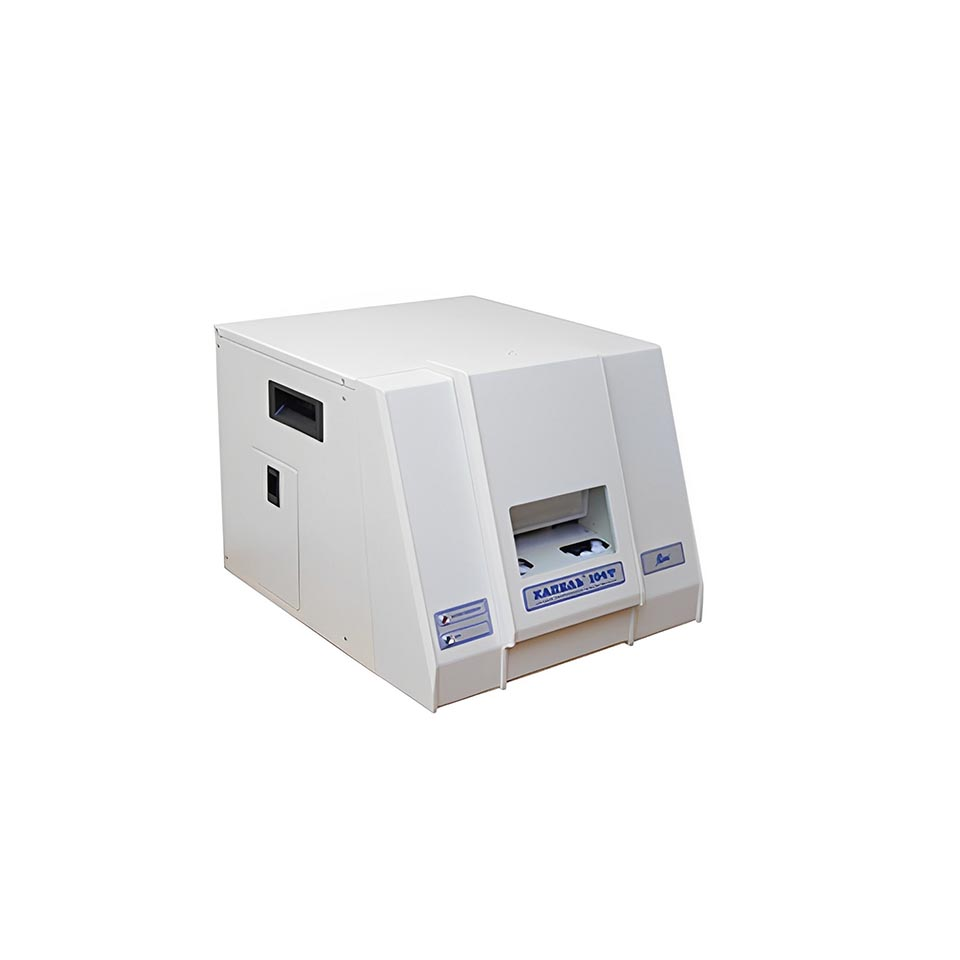
Capillary electrophoresis system Kapel-104T
Capillary electrophoresis system Kapel-104T used to separate ions by charge under the influence of an electric field. For research and routine analytical tasks. Main Applications: analysis of environmental objects - natural, drinking water, waste water, soil, sediments: inorganic cations and anions, herbicides. quality control, authenticity and safety drinks, food products, food raw materials and dietary supplements: organic acids, inorganic cations and anions, preservatives, amines, proteins, etc. veterinary medicine and feed quality control and feed raw materials: amino acids, vitamins, organic acids, inorganic cations and anions, antibiotics, micro- and macroelements; pharmaceutical industry: control of the safety and quality of substances, finished medicinal products funds; forensic examination: analysis of narcotic and explosive substances etc.; clinical biochemistry: ions, amino acids, amines, peptides in biofluids; chemical industry: control of raw materials and by-products. All procedures, from sample injection to washing capillary are produced automatically using a specialized Elforan software, which reduces time and likelihood errors during analysis, improving the reproducibility of analysis results. Currently, more than 25 methods and draft methods have been developed for Kapel systems, developed and introduced into ten national standards of the Russian Federation apply, six of which have interstate status: GOST 31480-2012 (formerly GOST R 52347-2005) “Compounded feed, compound feed raw materials. Content Definition amino acids (lysine, methionine, threonine, cystine and tryptophan) by the method capillary electrophoresis"; GOST 31483-2012 (formerly GOST R 52741-2007) “Premixes. Determination of vitamin content: B1 (thiamine chloride), B2 (riboflavin), B3 (pantothenic acid), B5 (nicotinic acid and nicotinamide), B6 (pyridoxine), Bc (folic acid), C (ascorbic acid) by capillary electrophoresis"; GOST 31765-2012 (formerly GOST R 53154-2008) “Wines and wine materials. Determination of synthetic dyes by capillary electrophoresis"; GOST 31867-2012 (formerly GOST R 52181-2003) “Drinking water. Determination of anion content by ion methods chromatography and capillary electrophoresis"; GOST 31869-2012 (formerly GOST R 53887-2010) “Water. Methods for determining the content of cations (ammonium, barium, potassium, calcium, lithium, magnesium, sodium, strontium) using capillary electrophoresis"; GOST 31941-2012 (formerly GOST R 52730-2007) “Drinking water. Methods for determining the content of 2,4-D"; GOST R 52841-2007 “Products winemaking Determination of organic acids by capillary method electrophoresis"; GOST R 53193-2008 “Alcoholic drinks and non-alcoholic. Determination of caffeine, ascorbic acid and its salts, preservatives and sweeteners by capillary electrophoresis"; GOST R 53971-2010 “Products winemaking Determination of the mass concentration of pesticides of the group triazoles by capillary electrophoresis in combination with solid phase extraction"; GOST R 55569-2013 “Feed, compound feed and raw materials for their production. Method for measuring the mass fraction of amino acids by capillary electrophoresis." GOST R 56373-2015 “Feed and fodder additives. Determination of the mass fraction of organic acids by the method capillary electrophoresis"; GOST R 56374-2015 “Feed, compound feed, feed raw materials. Determination of the mass fraction of ammonium, potassium cations, sodium, magnesium and calcium by capillary electrophoresis"; GOST R 56375-2015 “Feed, compound feed, feed raw materials. Determination of the mass fraction of chloride, sulfate, nitrate and phosphate ions by capillary electrophoresis." Drop kits for determination are available upon additional request: Set for determination of cations (NH4, K, Na, Mg, Ca) in mineral, organomineral and organic fertilizers. Set for determination of anions (chloride, nitrate, sulfate, fluoride, phosphate) in mineral, organomineral and organic fertilizers. Kit for determination of amide nitrogen (urea, urea) in fertilizers. Kit for determination of boron in fertilizers. Kit for the determination of chlorites, chlorates, perchlorates in drinking water, including those packaged in containers. Manba: https://www.nv-lab.ru/catalog_info.php?ID=1487
- Parameter: Value
- Operating detection wavelength, nm: 254
- Range of changes in operating voltage on the capillary, kV: 1…25
- Detection limit of benzoic acid (with positive polarity of the high-voltage unit) at a signal-to-noise ratio of 3:1, µg/cm3, no more than: 0.8
- Detection limit of chloride ions (with negative polarity of the high-voltage unit) at a signal-to-noise ratio of 3:1, μg/cm3, no more than: 0.5
- Limit of permissible relative standard deviation (RMS) of the output signal by peak area, %: 5
- Limit of permissible relative standard deviation (RMSD) of the output signal for 8 hours of operation, %: 6.5
- Time to establish operating mode, min, no more than: 30
- Power, V/Hz: 220/50
- Power consumption, W, no more: 150
- Dimensions (L×W×H), mm, no more: 420x460x360
- Weight, kg, no more: 25