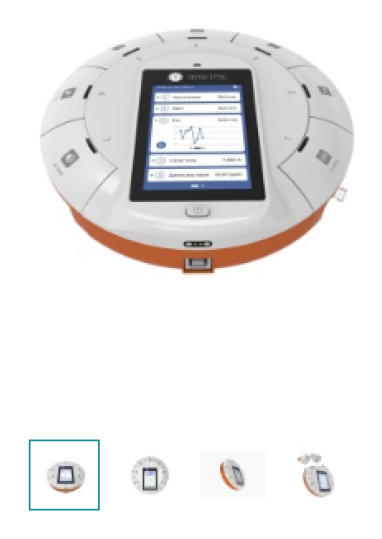
Digital laboratory SenseDisc Environment-kit for experiments in natural history
The digital environment lab SenseDisc®Environment is the ideal tool for conducting science experiments in the field. The device is equipped with a battery that provides more than 150 hours of battery life. Its functionality allows students to engage in practical science in a fun and effective way. Built-in sensors: Accelerometer (3 axes), GPS, Ambient thermometer, Barometer. Removable measuring sensors: Dissolved oxygen, Acid-base balance, Relative humidity, Sound, UV radiation, Light, Temperature. Each laboratory comes complete with: a set of measuring devices and converters accompanying each sensor; methodological manual with options for laboratory work and experiments; USB cable and AC adapter for charging and connecting the device to a computer; disk with SenseDisc iLab software; bag for storing and carrying laboratories. Digital Lab Software Provides a wide selection of preset templates for experimentation. The interface is in the form of many folders with loose sheets; the display style can be set independently. Function of full coordination of statistics and data. Saving settings to create an experiment template. Saving the experiment result and creating a playable file. Unique operating interface for easy operation.
- (Range: 0-400V/m2, Accuracy: :±5%)
- A UV sensor is an experimental instrument used to detect the UV range of radiation between 100 nm and 400 nm in the electromagnetic spectrum. The sensor can proportionally transform the received UV signal into an output voltage pulse.
- Establishing the share of the UV spectrum in the photoelectric effect.
- The influence of different intensities of UV radiation on the level of survival of biological material.
- pH level sensor SenseDisc S1002:
- (Range: 0~14pH, Accuracy: ±0.2pH)
- The pH electrode consists of an internal reference electrode and a glass electrode. Mainly used to measure the concentration of hydrogen ions in a solution and show its current pH level.
- Acid-base titration (neutralization).
- pH level of various solutions.
- Acidity of phenol.
- The mechanism of maintaining a stable pH level by various organisms.
- Study of the effect of pH level on pectinase activity.
- Sound level sensor SenseDisc S0021:
- (Range: 40-92 dB, Accuracy: ±4 dB)
- The sound sensor not only measures sound intensity (dB) within two ranges, but can also be used to measure sound waveform (mV) directly. Thanks to the frequency response indicator, the sensor can measure the speed of sound and capture the shape of the sound wave.
- Measurement of sound intensity level.
- Measurement of environmental noise intensity level.
- Measurement of the acceleration of sound propagation in air.
- Sound wave synthesis.
- Sound wave resonance.
- Light sensor SenseDisc S0019:
- (Range: 0-55000 Lux, Accuracy: ±5%)
- Light sensors are built using a silicon photocell as a sensing agent: it can transform light intensity into a voltage signal while maintaining direct proportionality. For this sensor, the effective light spectrum ranges from 380 nm to 730 nm, making it an ideal sensor for visible light sensitivity.
- Study of the relationship between lighting intensity and distance.
- Study of diffraction, interference and polarization of light.
- SenseDisc S1008 relative humidity sensor:
- (Range: 0-100%, Accuracy: ±4 (10%~90%RH))
- The relative humidity sensor is based on a prototype device that is sensitive to humidity levels through the use of polymer electrical capacitance technologies (solid-state capacitor). Its electrical capacity will vary depending on the level of environmental humidity, thus allowing monitoring of this parameter.
- Measuring changes in ambient humidity.
- Hygroscopicity of concentrated sulfuric acid.
- Design and creation of an eco-cylinder and monitoring its stability.
- SenseDisc S1005 dissolved oxygen sensor:
- (Range: 0-20 mg/L, Accuracy: ±0.1 mg/L)
- The probe of the dissolved oxygen sensor works according to the polarogram measurement principle. The probe electrodes consist of an anode, a cathode and a membrane. During use, the electrode is immersed in a solution - the potential between the anode and cathode creates an electrochemical reaction.
- Study of respiration mechanisms in Saccharomyces (yeast fungi).
- Study of the properties of dissolved oxygen in various aquatic environments.
- Study of factors influencing photosynthesis processes.
- Temperature sensor SenseDisc S0009:
- (Range: -40 C - +135'C, Accuracy: ±0.5 C)
- The temperature sensor uses an electronic negative temperature coefficient (NTC) sensor - when the ambient temperature changes, the resistance of the sensor changes accordingly. Typically, temperature instruments do not require zero calibration and have relatively high stability of readings, so the sensor is especially often used for measuring low and medium temperatures.
- Natural cooling of water.
- Cooling of evaporating liquid.
- Converting working energy into internal energy.
- Study of the phenomenon of thermoelectricity.
- Convex lens convergence effect.
- Supported Operating Systems Standalone, Windows, iPad, Android, Mac
- Built-in sensors Accelerometer (3 axes), GPS, Environmental thermometer,
- Barometer
- GPS Data Log Yes
- Remote data collection Yes
- Max sampling rate 100,000/s
- Sampling resolution 12-bit
- Internal data storage 4 MB
- Battery (li-ion) 1800mAh
- Battery life > 150 hours
- Display 3.5′ TFT 480*320 touch
- USB 2.0 connection
- Wireless connection Bluetooth 2.0&4.0
- Size Width 170 mm, height 46 mm
- Operating temperature range -10 to 50 °C
- Compliance with CE, FCC, CCC standards
- External power supply 100-240V AC/ 5V DC 1A
- SenseDisc iLab software
- External sensors 7 connectors (9 sensors)