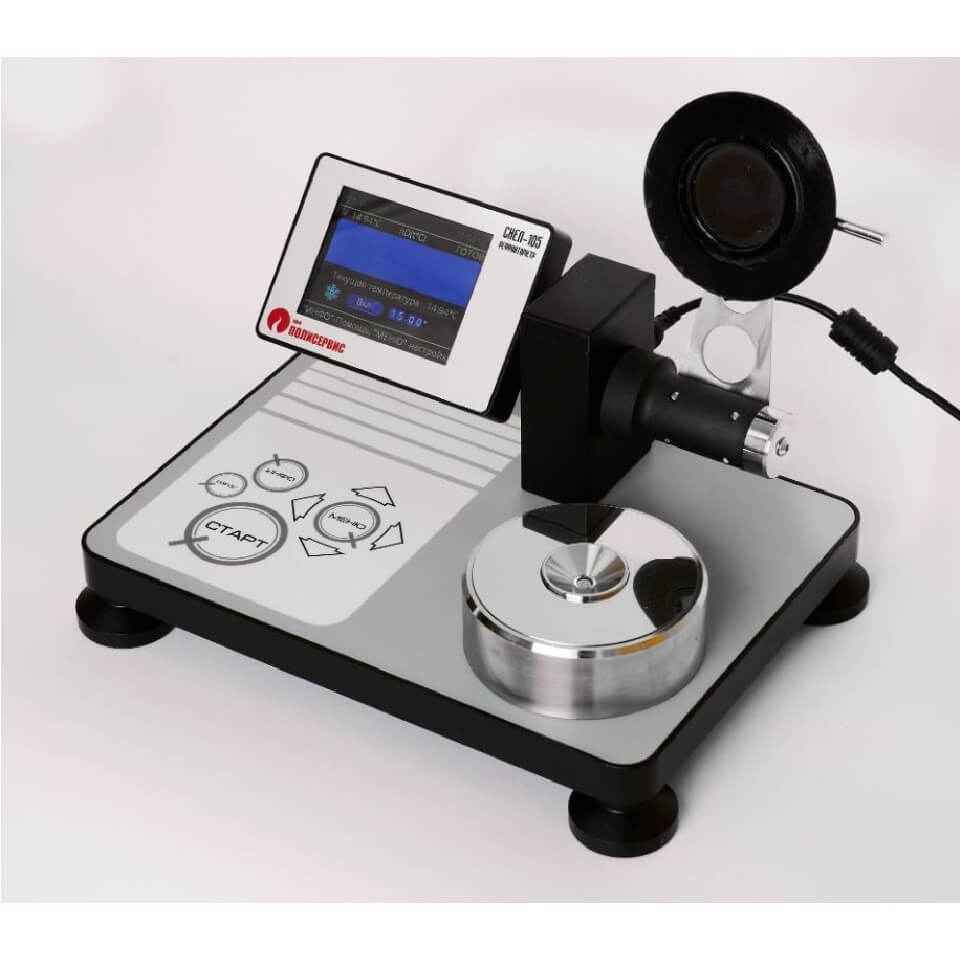
Refractometer SNEL-105 digital laboratory
Abbe refractometer SNEL-105 digital high-precision automatic Designed to determine the refractive index of liquid media, solutions, emulsions with a nD20 value from 1.33 to 1.58, as well as to measure the mass fraction of sucrose in aqueous solutions in accordance with the international sugar scale % Brix with subsequent automatic display of their values, as well as the time, date and serial number of the device on a liquid crystal electronic display. Works with liquid transparent and dark samples, emulsions and solutions in the following modes: measurements at ambient temperature, measurements at a given temperature, measurements in temperature error compensation mode. In this case, the method of directly applying the sample to the measuring prism is used. The refractometer automatically measures the temperature of the measuring cell, displays its value on an electronic display, and also allows it to be maintained within a specified narrow range, which helps obtain accurate measurement results. The refractometer provides an additional optional ability (on a separate order) to load from one to five other scales into the refractometer’s memory: for example, a scale for the percentage of salt in an aqueous solution, a scale for the percentage of alcohol in an aqueous solution, and others. Operating principle It consists of recording the limiting (critical) angle of refraction when directing light to the interface between two media with different refractive indices. One of the media is a refractometer measuring prism made of sapphire with a high refractive index, and the other is an analyte with a lower refractive index. As a result of the phenomenon of total internal reflection of light, a “light-shadow” boundary corresponding to the limiting angle is observed. The position of the light-shadow boundary in the plane of the photodetector changes depending on the refractive index of the analyzed substance; it is different for different substances. Light from the radiation source, formed by the optical system, hits the sample under study from below at different angles of refraction. The signals received from the photodetector, the amplitude of which is determined by the position of the light-shadow boundary, are converted by an analog-to-digital converter into a digital code and, in accordance with the program installed in the microprocessor, are converted into the values of the refractive index and mass fraction of sucrose. The refractometer uses an LED with a maximum radiation intensity at a wavelength of 589.3 nm, which corresponds to the wavelength of the yellow line D in the sodium emission spectrum. A refractometer is an automated digital measuring instrument consisting of an optical system with a measuring prism, built according to the Abbe scheme, photoelectric receiver and analog-to-digital converter. Elements and sensors are installed under the measuring prism to regulate and record the temperature of the test sample at the boundary with the measuring prism. The sample temperature is stabilized by a thermostat using Peltier elements. Since the optical design of the refractometer is based on the use of the laws refraction and reflection of light only inside the measuring prism, then the measurement results do not affect the transparency of the sample under study and the presence of light-scattering insoluble substances in it inclusions and gas bubbles. Via the USB port in the refractometer, testing can be carried out during the setup process. It is possible to save measurement and calibration results, as well as messages about mistakes. Language for displaying data and service messages on the display: Russian and English. An external DC source is used as the power source. The refractometer body is made of milled duralumin and steel using caprolon and is sealed to prevent unauthorized entry. The cuvette compartment and the inside of the hinged lid above it are made of stainless steel. The keyboard of the device is made of a chemical-resistant, moisture-proof membrane. Applications in medicine (determination of protein in urine, blood serum, determination of urine density, analysis of brain and joint fluids, density of subretinal and other eye fluids); in pharmaceuticals (study of aqueous solutions of drugs); in the food industry (analysis of the quality of products, semi-finished products and raw materials at sugar and bread factories, confectionery factories); in sanitary and epidemiological control laboratories; in veterinary clinics, medical and research laboratories; for metrological quality control of various liquids; when determining the quality of fuels and lubricants (for example, in civil aviation), etc. Use only indoors with air temperature from +15 to +30 °C and relative air humidity (without condensation) from 30 to 80%. Manba: https://www.nv-lab.ru/catalog_info.php?ID=10029
- Parameter: Value
- Display: LCD color TFT, 320×240 dots display, with LED backlight
- Keyboard: push-button, protected, 8 keys
- Thermostat: solid-state Peltier element
- Software: SNEL software version 1.012/4.098
- Light source: LED with a wavelength of 589.3 nm
- Interface: USB 1
- Overall dimensions (L × W × H), mm: 260 × 190 × 140 (measuring unit)
- Weight, kg: 2.8
- Supply voltage, V: 12
- Power consumption, W, no more: 24
- External power supply: GST25A12-P1J, Mean Well
- Input: IEC/EN 60320-1/C14, degree of protection I
- Fuses (protection type): automatic with recovery
- MTBF, h, not less: 4500
- Average service life years: 10
- Parameter: Value
- Measuring range, nD: 1.3300 – 1.5800
- Display resolution of values, nD: 0.00001
- Limits of permissible absolute error, nD: 0.00005
- Measuring range on the ICUMSA scale °Brix, %: 0 – 85
- Display resolution on the ICUMSA scale °Brix, %: 0.01
- Limits of permissible absolute error on the ICUMSA scale °Brix, %: ±0.05
- Control range, °C: 15 – 30
- Discreteness of displaying values, °C: 0.01
- Limits of permissible absolute error, °C: ±0.1
- Stability of maintaining sample temperature, °C: ±0.05
- Mandatory measuring scales:
- - thermal stabilization;
- - temperature compensation for aqueous solutions of sucrose;
- - concentration of aqueous solutions of sucrose: nD (t),
- nD (20),
- %Brix
- Number of custom scales (optional): 5