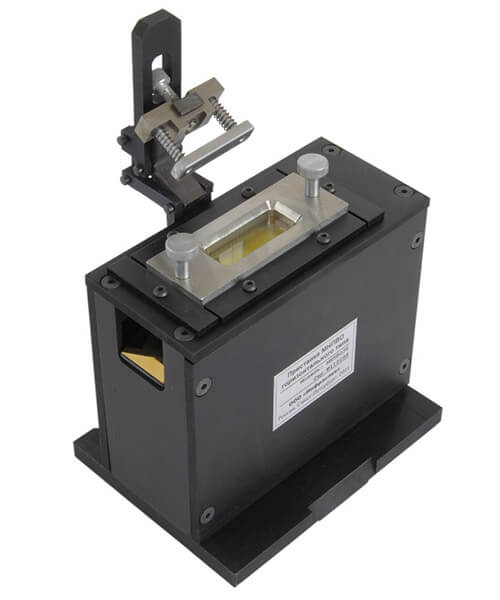
Horizontal reflection attachment MNPVO36
Horizontal reflection attachment MNPVO3 The horizontal multiple attenuated total reflection attachment MNPVO36 is designed for studying the chemical composition of liquid media, fine non-abrasive powders and polymer films. The MATIR (multiple attenuated total internal reflection) method, being an analogue absorption spectrometry, allows you to significantly simplify the preparation samples and can be used to implement express methods for product quality control. The MNPVO36 prefix consists of three parts: console base, MAPVO prism in the holder, clamping device. The optical design of the attachment includes two flat mirrors, one of which directs the flow of IR radiation to the input face of the ATR prism, the other receives radiation from the output face of the prism and directs it to the output spherical mirror of the camera ditch. The ATR prism is fixed in the holder. The edges of the holder and the upper edge of the prism form a tray designed to accommodate samples. The holder with the prism is placed in a fixing recess on the upper surface of the attachment base. The MNPVO36 attachment successfully replaces cuvettes and devices used for analyzing liquid, semi-liquid and solid substances. Prefix multiple broken Total internal reflection is suitable for both qualitative and quantitative analysis. Sample preparation boils down to placing the sample on a prism crystal. The method of applying the sample depends on its viscosity. For example, liquids with low viscosity can be conveniently applied using a pipette. Polymer samples are mechanically pressed against the surface of the prism. The spectrum of a “clean” prism is used as a comparison spectrum, i.e. First, the spectrum is taken in the absence of a sample. For total internal reflection to be observed, the prism material must have a higher refractive index than the sample. The most commonly used are ZnSe, KRS-5, Ge, Si. Advantages of the MAPVO method: Easy sample preparation. It is enough to place the test sample (liquid, fine powder) in a bath, the bottom of which is formed by an ATR prism. Polymer samples are mechanically pressed against the surface of the prism. High reproducibility. The effective thickness of the absorbing layer is reproduced with high accuracy, in contrast to the thickness of optical cells, since it is determined only by the material and parameters of the ATR prism and the refractive index of the substance under study. Easy to maintain. MAPVO devices do not require assembly and disassembly during the preparation and measurement process, and do not contain hard-to-reach cavities that could complicate washing. High performance. The time for obtaining a spectrum, including sample placement, with standard requirements for resolution and photometric accuracy does not exceed 1–2 minutes. Features of the MNPVO36 set-top box: Up to 7 internal reflections for maximum sensitivity at low component concentrations. The standard prism crystal material is ZnSe (dimensions: 36×16×4 mm, 45°). Other options are possible - a prism made of Ge or Si. The effective thickness of the absorbing layer, depending on the material and parameters of the prism, can be selected within the range of 1-50 microns. High accuracy of reproduction of the effective thickness of the absorbing layer. The time for obtaining a spectrum, including sample placement, with standard requirements for resolution and photometric accuracy does not exceed 1-2 minutes. The clamping device allows you to press powders and films to the surface of the prism. Manba: https://www.nv-lab.ru/catalog_info.php?ID=8735