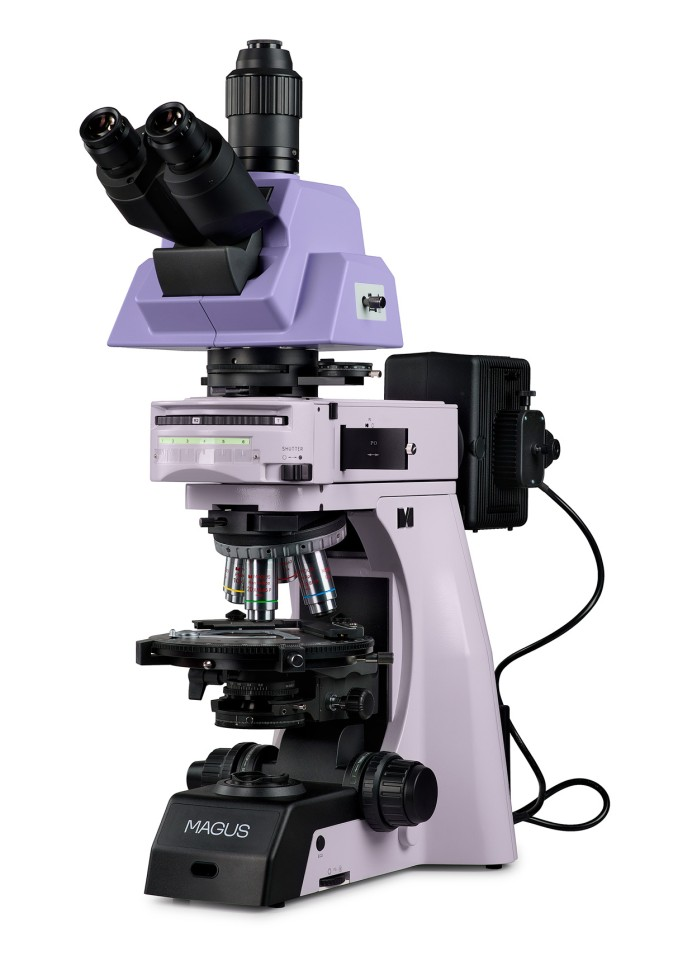
Optical microscope MAGUS Pol 890
Microscope for scientific research and industrial control. Designed for studying objects in polarized and normal light. Installation of optional components will allow the use of dark field and phase contrast methods in transmitted light, as well as dark field, differential interference contrast and reflected light luminescence. Geological sections and thin anisotropic biological and polymer objects are studied in transmitted light. Opaque polished sections with one side polished are examined in reflected light. The thickness of the polished section is arbitrary, usually 5–10 mm. The microscope allows you to study opaque objects up to 15 mm thick. To form an image, a polarizing microscope uses the optical property of birefringence of anisotropic objects. Plane-polarized light, when passing through an anisotropic sample, is split into two beams and changes the plane of polarization. The analyzer brings the oscillations of the beams into one plane, where they interfere. The bright, high-contrast image changes color as the stage rotates. Plan-semi-apochromatic microscope objectives are free from internal stress. The intermediate tube contains an analyzer and a Bertrand lens, and there is a slot for installing compensators. The microscope is used in crystallography, petrography, mineralogy, forensics, medicine and other fields of science. Visual attachment Trinocular imaging head with infinity-rated optics. The user selects the most comfortable angle of inclination of the visual attachment in the range from 0 to 35°. The digital camera is installed in a vertical tube with an imaging channel. The luminous flux is switchable 0/100, 100/0 or 80/20. The basic package includes 10x/22 mm eyepieces with diopter correction and remote pupil for working with glasses. Revolving device Revolver with 5 lenses. The free hole is used to adjust the position of the reflected light illuminator lamp. The laboratory assistant also installs an additional lens in the free slot of the revolver, which will allow one to obtain another magnification. The design of the revolver, tilted toward the tripod (“away from the observer”), frees up space in the front of the stage, and the user sees the lens that introduced the rays. The revolver sockets are centered to align the optical axis of the lens and microscope. Above the revolver there is a slot with a plug for installing compensators. Lenses The objectives are plan-semi-apochromatic to infinity, designed specifically for research in polarized light: voltage-free optics ensure that birefringence comes from the sample and not from the optical elements. Provide better correction of chromatic and spherical aberration compared to planchromats. 5x and 10x objectives are designed to work with or without a cover glass, 20x and 50x objectives are designed to work without a cover glass. The parfocal height of the lenses is 60 mm. Turret for installing contrast modules Above the lens revolver there is a turret for installing contrast modules. 6 modules can be installed. Rotating the turret changes the observation mode, switching from one contrast method to another occurs quickly and without complex settings. Focus The coarse and fine focusing knobs are coaxial and located low. The researcher places his hands on the table and takes a comfortable position for working on the microscope. The coarse focus lock knob helps you quickly adjust the microscope after changing the subject of study. The handle is located on the left side of the microscope on the same axis as the focusing mechanism. The ring on the right side adjusts the rigidity of the coarse focusing stroke. The user adjusts the comfortable firmness for work. Subject table The stage rotates 360° to observe the color change of the sample when the polarizer and analyzer are crossed and is fixed in the selected position. The rotation angle is marked on the table. Using a vernier, measurements are carried out with an accuracy of 0.1°. The design of the stage provides for centering using two screws, since the analysis of an anisotropic object in polarized light requires exact coincidence of the axis of rotation of the stage with the optical axis of the microscope. Light sources The reflected and transmitted light illuminators contain 100-watt halogen lamps. Halogen lamps emit light at a color temperature that is comfortable for the eyes. The 100-watt lamp is bright enough to work with lenses ranging from 4x to 100x magnification in bright field and polarized light. Indirect Lighting System The lighting system implements the Köhler method. The field and aperture diaphragms are centered in the optical axis at the factory and do not require additional centering. If necessary, the diaphragms are adjusted with centering screws. The light source is centered along three axes. The analyzer and polarizer implement the polarization method. The polarizer is stationary, the analyzer rotates 360°, the analyzer has a vernier scale for precise angle setting. A set of light filters will help you correctly adjust color rendering. Transmitted light lighting system An adjustable field diaphragm, a centered and height-adjustable condenser with stress-free optics, an adjustable aperture diaphragm and a flip-up lens realize Köhler illumination adjustment. The folding lens is removed from the beam path for lenses with low magnification and returned back for lenses with magnification greater than 10x. The polarizer rotates in the range of 0–360°, and the scale has marks for four rotation angles: 0°, 90°, 180°, 270° relative to the analyzer. The analyzer rotates 360°, the analyzer has a vernier scale for precise angle setting. Köhler illumination in reflected and transmitted light Correct adjustment of the microscope according to Köhler improves the quality of the image of the object. With this lighting, the resolution limit on each lens is reached. Uniform illumination of the field of view without darkening at the edges. The object of interest is brought into focus and the artifact images are removed. Observing objects in polarized light The analyzer is introduced into the beam path to observe objects in polarized light. As the polarizer and analyzer rotate, the polarization angle changes. When the microscope table is rotated, a change in the refraction of light by the sample is observed depending on the polarization angle. Conoscopic examinations are performed using a Bertrand lens. Compensators are used to enhance the contrast of objects with weak birefringence.
- Microscope type: polarizing
- Purpose: laboratory
- Magnification, times: 50 - 500
- Attachment type: trinocular
- Microscope attachment: Siedentopf, light division 0/100, 100/0, 80/20
- Eyepiece tilt angle: 0–35°
- Diopter adjustment of eyepieces: ±5 diopters on both tubes
- Interpupillary distance, mm: 47 - 78
- Mounting diameter of eyepieces: 30 mm
- Eyepieces: 10x/22 mm, with remote pupil (2 pcs.)
- Lenses: semi-apochromatic, 5x/0.15, 10x/0.30, 20x/0.45, 50xs/0.80
- Parfocal height: 60 mm
- Revolving device: for 5 lenses
- Condenser: Centerable and height-adjustable condenser NA 0.9/0.25 with adjustable aperture diaphragm and flip-up lens; stress-free optics
- Diaphragm: field, aperture
- Köhler lighting: yes
- Transmitted light polarizer: with 0°, 90°, 180°, 270° marks on the scale, 360° rotatable
- Reflected light polarizer: polarization module in the turret
- Intermediate attachment: analyzer with 0–360° rotation and scale, Bertrand lens, slot for installing compensators, conoscopic/orthoscopic switching
- Compensator: λ compensator; λ/4 compensator; quartz wedge
- Focusing: coaxial, coarse (with locking and rigidity adjustment mechanisms) and fine (0.001 mm)
- Backlight type: halogen
- Lighting method: transmitted and reflected light
- Backlight type: 12V/100W
- Backlight power: mains 220 V/50 Hz
- Research method: bright field, polarization
- Package size: 72 × 76 × 53 cm
- Package weight: 31 kg