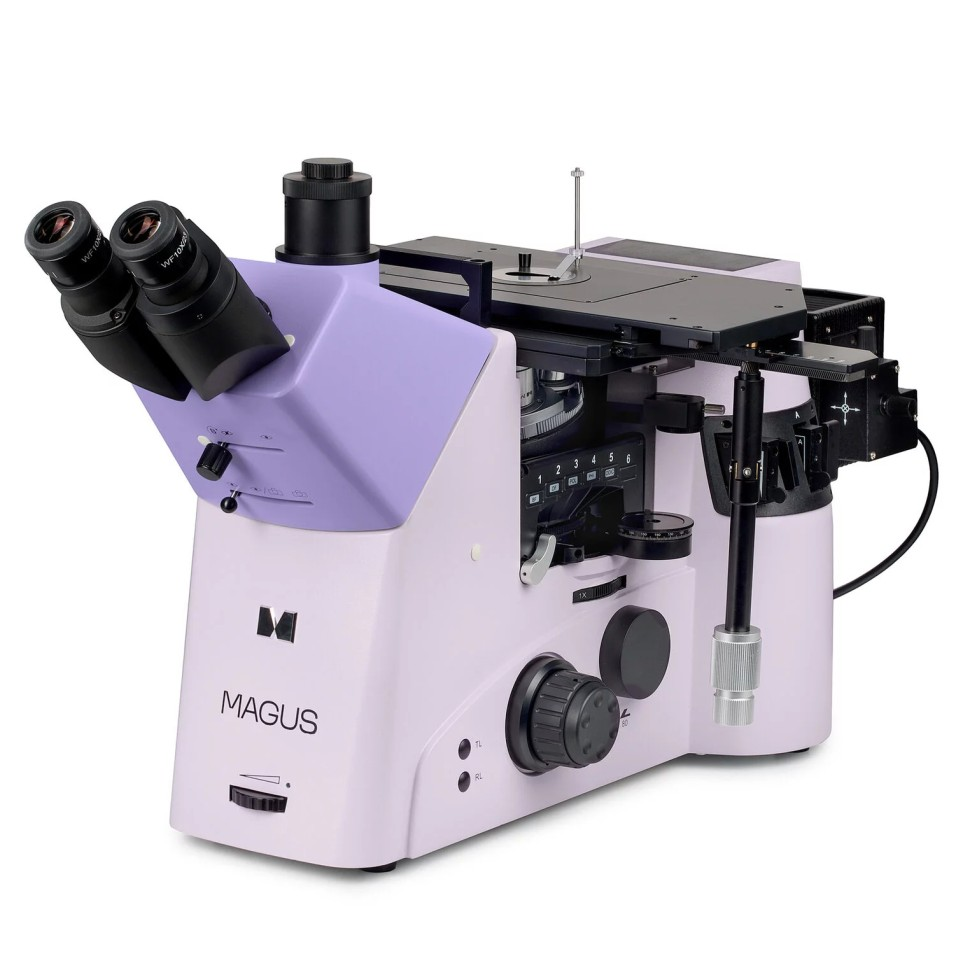
Optical microscope MAGUS Metal V790 DIC
The microscope is designed to study the microstructure of metals and alloys, semiconductor materials and other opaque objects. The inverted design of the microscope does not limit the geometry of the research object, but only limits its weight - up to 30 kg. One face of the sample is subjected to special processing and the sample is placed on the table with this surface down. With this microscope, opaque objects are examined in reflected light using the bright field, dark field, simple polarization and differential interference contrast methods. DIC is an advanced polarization contrast technique. The method increases the depth of field and image clarity, provides additional information about the structure of the object under study, and visualizes irregularities on the surfaces being studied in color. Flat surfaces are painted equally, but a surface with even minimal differences in height will be uneven in color. The object of study appears in relief. The microscope is used at enterprises of the metallurgical, mechanical engineering, aerospace, nuclear and energy industries, in research laboratories and technical universities. Visual attachment Trinocular visual head and optics designed for infinity. The 45° tilt angle provides comfortable conditions for the researcher to work while sitting or standing. The user assumes a natural posture, and fatigue does not accumulate during the working day. A Bertrand lens is built into the visual attachment; its insertion into the optical path is carried out using a regulator on the front of the attachment. Conoscopic examinations are performed using a Bertrand lens. The digital camera is installed in the vertical tube of the visual attachment or in one of the side imaging ports on the microscope body. The light output on the trinocular head is switchable 100/0, 50/50 or 0/100. The light division on the right photoport is 100/0 and 20/80; on the left – 100/0 and 0/100. The basic package includes 10x/23 mm eyepieces with diopter correction and remote pupil for working with glasses. Revolving device The revolver for 5 lenses is mounted on a tripod under the table. The differential interference contrast method is implemented using DIC sliders: one is used with low magnification lenses, the other with medium and high magnification lenses. The DIC slider is installed in a special slot of the turret device. Turret for installing contrast modules Under the objective revolver on the microscope stand there is a turret for installing contrast modules. 6 modules can be installed. Rotating the turret changes the observation mode, switching from one contrast method to another occurs quickly and without complex settings. Switch with additional magnification lens A rotary switch is used to insert the main 1x lens or an additional 1.5x magnification lens into the optical path. A magnifying lens increases the magnification of a microscope without purchasing or installing additional accessories. The switch is located on the right side of the microscope body under the objective nosepiece. Lenses Semi-apochromatic infinity lenses with an extended working distance work using the bright-dark field method. Provide better correction of chromatic and spherical aberration compared to planchromats. Focus Coaxial coarse and fine focusing knobs are located at the bottom of the body on both sides of the tripod. The right fine focusing handle has special recesses for fingers, the left one has a scale. The coarse focus lock knob helps you quickly adjust the microscope after changing the subject of study. The handle is located on the left side of the microscope on the same axis as the focusing mechanism. The ring on the right side adjusts the rigidity of the coarse focusing stroke. The user adjusts the comfortable firmness for work. Subject table The object is moved by moving the table surface along two axes. An insert with a hole of a suitable diameter is installed in the center of the table. A clamp is used to fix the object. The three-layer coating protects the table from scratches and other surface damage when working with heavy and large samples. The long tiltable table control handle ensures user comfort while working: the hand rests on the table without strain. The handle can be installed on the right or left side of the table. Light source The lantern contains a 100-watt halogen lamp. It shines bright enough to work on lenses with magnifications from 4x to 100x, not only in bright field and polarized light, but also in dark field. The halogen lamp emits light at a color temperature that is comfortable for the eyes. Indirect Lighting System The lighting system implements the Köhler method. The field and aperture diaphragms are centered in the optical axis at the factory and do not require additional centering. If necessary, the diaphragms are adjusted with centering screws. The analyzer and polarizer implement the simple polarization method. The polarizer is stationary, the analyzer rotates 360°. A set of light filters helps to correctly adjust color rendering. Ergonomic design Physical discomfort causes fatigue and reduces work productivity. The ergonomic design of a microscope plays an important role in everyday scientific research. MAGUS Metal V790 DIC provides user comfort during operation. The microscope is operated with minimal hand movement, since the long stage control handle and fine focusing knob are located in the same working area. Focusing knobs are located at the bottom of the body. The user does not strain his hands while working. Thanks to the smooth movement of the mechanism, the user can focus on the object without effort.
- Microscope type: metallographic
- Purpose: research
- Magnification, times: 50 - 1500
- Attachment type: trinocular
- Microscope attachment: Siedentopf, with Bertrand lens, light division 100/0, 50/50, 0/100
- Eyepiece tilt angle: 45°
- Diopter adjustment of eyepieces: ±5 diopters on both tubes
- Interpupillary distance, mm: 48 - 75
- Mounting diameter of eyepieces: 30 mm
- Eyepieces: 10x/23 mm, with remote pupil (2 pcs.)
- Lenses: semi-apochromatic, 5x/0.15, 10x/0.30, 20x/0.45, 50xs/0.80, 100xs/0.90
- Lenses/working distance, mm: 20 (5x); 11 (10x); 3.1 (20x); 1 (50xs); 1 (100xs)
- Parfocal height: 45 mm
- Revolving device: for 6 lenses
- Stage: 340x230 mm, two-axis three-layer mechanical, with coaxial X/Y handle with low position and deflection, maximum load 30 kg, stage inserts
- Range of movement of the drug, mm: 130 × 85
- Aperture: iris, field, aperture
- Köhler lighting: yes
- Additionally: polarizer and analyzer, DIC sliders for lenses, turret for installing contrast modules
- Focusing: coaxial, coarse (10 mm, with locking and rigidity adjustment mechanisms) and fine (0.002 mm, 0.2 mm/turn)
- Backlight type: halogen
- Lighting method: reflected light
- Backlight type: 12V/100W
- Illumination location: top
- Backlight power: mains 220 V/50 Hz
- Research method: bright field, dark field, polarization, DIC
- Package size: 76 × 61 × 58 cm
- Package weight: 34.9 kg