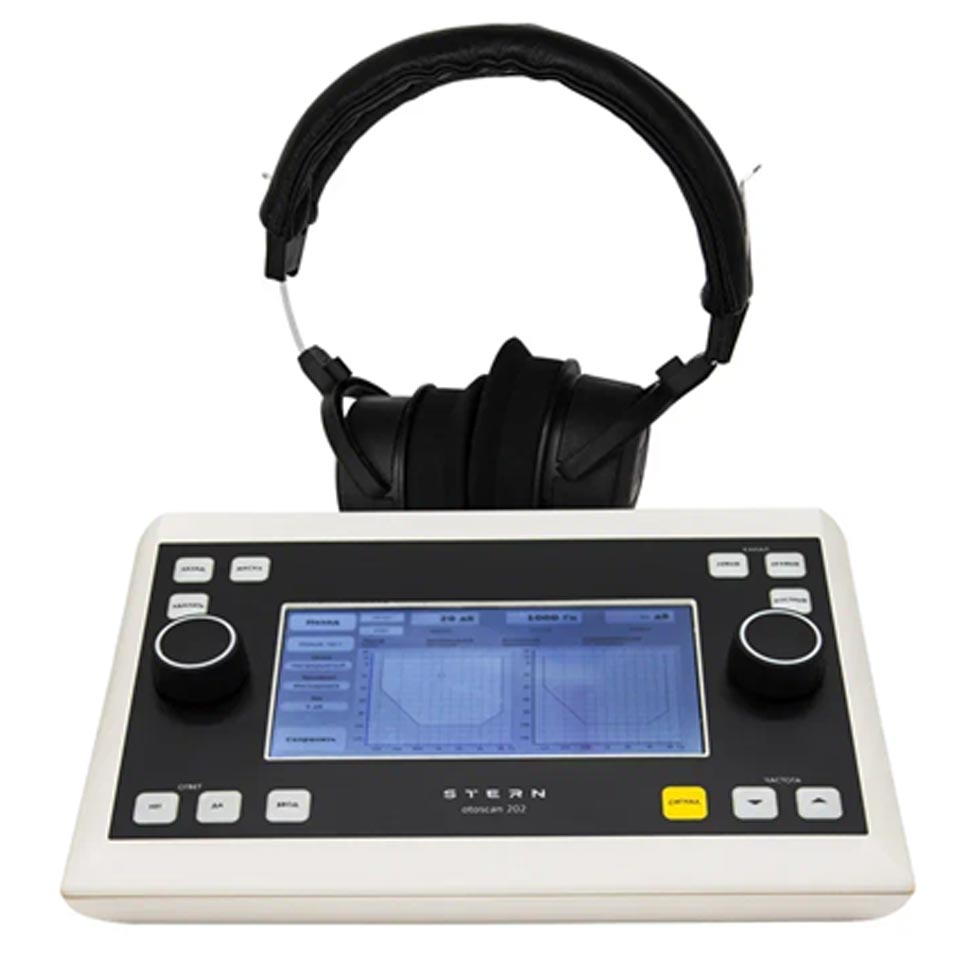
Desktop audiometer Stern Otoscan Pro 202
Desktop audiometer Stern Otoscan Pro 202 Stern Otoscan Pro 202 is a tabletop audiometer for air and bone conduction hearing examinations. The device is designed for diagnosing hearing impairment and allows you to perform a wide range of tests, including automatic modes. The audiometer is equipped with a touch screen with an intuitive interface, which ensures the convenience of the doctor’s work and speeds up the research. The device supports building audiograms, storing patient data and uploading them to external media. The Otoscan Pro 202 model is equipped with DD45 headphones, a patient response button and a bone vibrator, which allows for comprehensive hearing diagnostics in medical institutions of various profiles. Advantages of the Stern Otoscan Pro 202 audiometer A wide range of automatic and manual audiometric tests for comprehensive hearing diagnostics. Conducting air and bone conduction studies. Supports narrowband and wideband signal masking. 7-inch touch display with intuitive control interface. Built-in automatic tests: SISI, ABLB, STENGER, tone in noise and discomfort test. High measurement accuracy over a wide range of sound intensity from −10 to 120 dB. Extended frequency range for air and bone conduction. Possibility of constructing and visualizing audiograms in real time. Built-in memory for storing patient examination results. Transferring data to external media for archiving and processing. Supports connecting a keyboard and mouse for the convenience of the doctor. Complete with bone vibrator and DD45 headphones for a full cycle of research. Patient response button for performing functional tests. Correction of frequency response of channels to improve measurement accuracy. Possibility of use in an ENT office, clinics and specialized centers. Modes and tests Manual examination mode. Automatic examination mode. SISI test. ABLB test. STENGER test. Tone in noise test. Discomfort level test. Frequency response adjustment Adjustment of the amplitude-frequency response (AFC) of headphones, bone vibrator and masking signal ensures precise tuning of each channel on an expanded frequency grid. The option allows calibration at any signal level in the range from 40 to 80 dB, which increases the accuracy of audiometric studies and ensures measurement stability under various operating conditions. Description of tests Tone in Noise Test The “Tone in Noise” test is an audiometric research method based on assessing the hearing thresholds of tonal signals under conditions of dosed masking with white noise. The method allows you to analyze changes in auditory sensitivity under the influence of noise masking and is used to clarify the nature of hearing impairment, including the differentiation of cochlear and retrocochlear pathologies. During the study, tonal signals are presented against a background of gradually increasing noise levels, which provides an accurate assessment of the dependence of the auditory threshold on the intensity of the masking signal. Stenger test The Stenger test is used in audiometry to detect asymmetric or feigned hearing loss when both ears are simultaneously stimulated with sound signals of the same frequency. The method is based on the Sterng phenomenon, in which the patient does not perceive a sound presented to the ear with worse hearing if a more intense signal is simultaneously presented to the better hearing ear. The test allows you to objectively assess the reliability of audiometric data and is used in the differential diagnosis of functional and organic hearing impairment. ABLB test The ABLB test (aural loudness equalization test) is used in audiometry to evaluate differences in loudness perception between the left and right ears when stimulated with pure tones. The method allows us to identify the phenomenon of loudness leveling (recruitment), characteristic of cochlear lesions, and is used in the differential diagnosis of sensorineural hearing loss. During the study, the patient is alternately presented with sound signals of varying intensity in both ears until a subjective sensation of equal volume is achieved. SISI test The SISI (Short-Term Loudness Sensitivity Index) test is used in audiometry to assess a patient's ability to detect minimal changes in sound intensity. The method is based on the presentation of a tone signal of constant volume with a periodic short-term increase in intensity by a fixed amount. The test is used for the differential diagnosis of cochlear lesions of the auditory analyzer and allows one to assess the presence of the recruitment phenomenon. Uploading data to removable media The function of uploading data to removable media ensures that the results of audiometric studies are saved for subsequent analysis, archiving or transfer to medical information systems. Examination results are saved in the device’s internal memory with the ability to export to a USB drive, which simplifies working with patient data and provides quick access to examination history. Support for transferring data to external media allows you to use the results in documentation, dynamic monitoring of patients and reporting in clinical practice. Scope of delivery Audiometer Stern Otoscan Pro 202. DD45 headphones. Bone vibrator. Patient answer button. Using the Stern Otoscan Pro 202 audiometer The Stern Otoscan Pro 202 desktop audiometer is used: in otorhinolaryngological departments of medical institutions; in clinics and outpatient centers; in audiological and audiological offices; in diagnostic centers and multidisciplinary clinics; in rehabilitation centers involved in hearing restoration; in medical institutions conducting medical examinations and hearing screening tests; in private ENT offices and audiologist's offices. Manba: https://www.nv-lab.ru/catalog_info.php?ID=10547
- Characteristic: Meaning
- Device type: Table audiometer
- Air Conduction: Yes
- Bone conduction: Yes
- Frequency range (air conduction): 125 to 8000 Hz
- Frequency range (bone conduction): 500 to 4000 Hz
- Intensity range: −10 to 120 dB
- Number of test frequencies: 11
- Automatic mode: Yes
- Speech audiometry: No
- Graphing: Yes
- Bone vibrator: Yes
- Headphones: DD45 (included)
- Screen: Touch, 7 inches
- Memory: Device internal memory
- Data transfer: To flash drive
- Housing material: ABS plastic
- Dimensions, mm: 300×200×78
- Weight, kg: 1.5
- Power supply, V: 220
- Power consumption, W: no more than 45