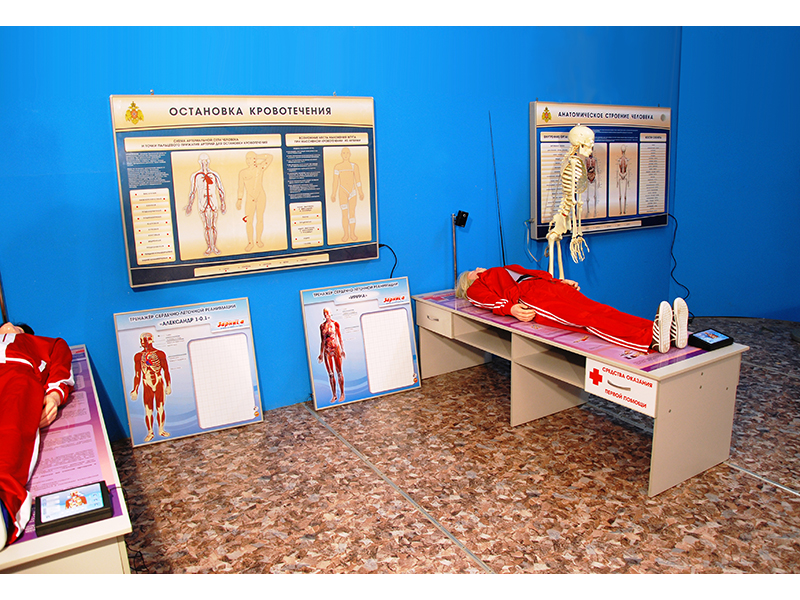
Multifunctional training complex Zarnitza "Reanimator"
The multifunctional training complex is a set of interconnected equipment aimed at increasing the efficiency of preparation for first aid at the scene of an incident. The equipment set includes training mannequins of different genders and ages, which allows you to more fully cover the entire spectrum of resuscitation effects on victims. Control over the correct implementation of resuscitation measures is carried out from the teacher’s workplace on a personal computer via a wireless communication channel and on the employee’s control and management panel. To practice first aid skills after resuscitation (stopping bleeding, first aid for burns, fractures, etc.), visual and electrified interactive stands are presented. The multifunctional training complex allows you to: acquire skills in performing cardiopulmonary resuscitation (CPR) on simulator mannequins of different genders and ages; identify and correct errors made during CPR at the training stage; acquire practical skills in practicing the Heimlich maneuver; psychologically prepare employees for external manifestations of all kinds of injuries in victims; acquire theoretical knowledge and practical skills in providing first aid for bleeding, burns, fractures and drowning; analyze the psychological aspects of behavior when providing first aid using the built-in video surveillance system and subsequently undergo corrective training in the psychological assistance class; study the basics of the human anatomical structure to acquire first aid skills for fractures using a stand with a real electrified skeleton model, which has control and training functions; practice skills in using first aid equipment, as well as available materials in emergency situations; the instructor conducts testing and assessment of knowledge on all the material covered using a multimedia program supplied complete with mannequin simulators. Composition of the training complex: Interactive multifunctional robot simulator for an adult victim (male), integrated with the interface hardware and software complex "Reanim-1.01". Simulator-dummy of an adult victim (woman). Interactive multifunctional robot simulator for teenagers. Infant training dummy. Simulator-dummy for practicing the Heimlich maneuver. Interface software and hardware complex "Reanim-1.01". Electrified stand-simulator "Stages of first resuscitation aid." Electrified stand-simulator "Stop bleeding". Electrified stand-simulator "Injuries and first aid measures." Electrified stand-simulator with a skeleton model "Anatomical structure of a human being". Multifunctional interactive stand-simulator "Providing first aid to victims." Three-element magnetic marker board "First Aid". Automated teacher's workstation. Stand "First aid for a drowning person". Stand "Transportation of casualties". Interactive multifunctional robot simulator for an adult victim (male), integrated with the interface hardware and software complex "Reanim-1.01" The robot simulator is designed to practice first aid skills at the scene of an incident and allows you to carry out the following activities: diagnosis of vital signs; performing cardiopulmonary resuscitation (CPR): 6 modes; providing first aid for bleeding; providing first aid for burns of varying severity; providing first aid for fractures, including applying splints and fixing bandages; transportation of the victim. Hygienic safety when working with a robotic simulator is achieved thanks to the following accessories: a custom training face mask with a one-way valve to prevent rebreathing and provide protection against cross-contamination; an additional set of sanitary napkins for artificial ventilation of the lungs. Anatomical landmarks of the robotic simulator determined by palpation: xiphoid process of the sternum; breast nipples. Anatomical features of the robot simulator: torso size and proportions are similar to the physique of an adult; limbs bend at the following joints: - hip, - knee, - elbow, - shoulder, - ankle; possibility of tilting the head back; anatomical seamless face mask, made of reinforced silicone, completely visually and tactilely creates an imitation of human skin, which allows for measures to remove the lower jaw and press the wings of the nose when performing CPR; overhead injuries and wounds of varying severity with the possibility of replacing and installing a robot simulator on any part of the body for practicing primary first aid skills: - laceration, - open fracture, - closed fracture. - gunshot wound, - cut wound, - 2nd degree burn, - 3rd degree burn, - puncture wound. Composition of the visual and testing equipment set: 1. Anatomical light-dynamic display to monitor the correctness of the actions performed. 2. A bedside module for displaying and controlling the operation of a robotic simulator, implemented on the basis of a tablet personal computer, with operation control via a wireless communication channel, which displays: mannequin modes; viewing the events of the events; sound volume; voice accompaniment of mistakes made after the end of the event; head position; pressing on the sternum; rib fracture; lung condition; condition of the belt; hand position; presence of pulse; connection to a mannequin; presence of errors; ventilation speed; compression frequency; compression depth. 3. Mobile testing module on the following topics: electric shock (voltage up to 1000 V); electric shock (voltage above 1000 V); electric shock due to a broken power line; falling from a support while repairing an electrical network; entering the zone of a phase-to-ground fault; electric shock household voltage 220 V; burns of the face and eyes with chemicals; poisoning when toxic substances enter the stomach; chemical burn without damaging the integrity of the skin; chemical burn with damage to the integrity of the skin; chlorine vapor poisoning; carbon monoxide poisoning. The mobile testing module is an electrified dynamic light panel with separate light indication, on which replaceable foils are applied for training and testing on the topics presented above. Magnetic-sensitive sensors are integrated into the design of the educational equipment to control the module using the interactive action of transceiver devices. There are two modes of working with the module: “Training” and “Control”. The mobile testing module can be operated autonomously thanks to the built-in rechargeable batteries, charged from the charger included in the delivery package. Multimedia software is installed on a personal computer (laptop), developed on the basis of the Windows operating system with an intuitive interface that does not require additional training for users with any level of training. In addition to displaying information about the progress of resuscitation measures carried out on a mannequin simulator, the program systematizes and displays errors made during training, and through feedback controls the operation of light-dynamic panels that display the correctness of operations at the student’s workplace. Visualization of the first aid process includes a dynamic representation of the internal processes occurring in the victim’s body during resuscitation measures. In addition to training and monitoring in the provision of CPR, the program implements a testing module to test knowledge of first aid for the following types of injuries: mechanical; thermal (burns, frostbite); chemical; electric. The database of videos and presentations allows you to complete a course of training in providing first aid to victims at the scene of an accident in the most complete practical and psychological terms. The equipment of the robotic simulator provides for operation in five main modes: training and demonstration mode used to practice individual resuscitation measures; test mode of resuscitation by one rescuer (2:15); test mode of resuscitation by two rescuers (1:5); resuscitation test mode (2:30); test resuscitation regimen (30:2) recommended by the European Resuscitation Council (ERC). To conduct training that is as close to real conditions as possible, and to evaluate the effectiveness of acquired skills, an additional “Expert” mode has been introduced, which allows CPR to be carried out without visualizing the actions being performed, with the subsequent issuance of a conclusion on the progress of the exercise. Functional features of the robot simulator: work from a network of 220 V; availability of the "Virtual Teacher" function; work via a wireless communication channel; laptop with pre-installed multimedia software. The tablet computer is pre-installed with multimedia software with an intuitive interface that does not require additional training for users with any level of training, including a testing program to test knowledge of first aid for the following traumatic factors: mechanical; thermal (burns, frostbite); chemical; electric. Simulator-mannequin for an adult victim (female) The mannequin simulator is an imitation of the body of an adult injured woman and is intended for practicing cardiopulmonary resuscitation techniques with the ability to control the quality of the exercises. The mannequin simulator is equipped with a system of sensors and devices designed to simulate human life processes diagnosed in the field, as well as to monitor the correctness of resuscitation measures. The training mannequin has the following features: imitation of female breasts; hair on a mannequin's head; The shape of the mannequin realistically imitates the female figure. The mannequin trainer has a movable connection between the body and the head, simulating the cervical spine. The design of the mannequin's torso includes parts and assemblies in the form of anatomical landmarks for the correct implementation of resuscitation measures. There are two modes of operation with the mannequin simulator, adult and child, which allow you to practice resuscitation skills in adults and children, respectively. When the exercise is performed correctly, a light and sound indicator is activated. On the lower part of the dummy's torso there is a safety instruction, which reflects the basic rules for using the simulator-dummy during training sessions. The mannequin simulator allows students, cadets or employees of enterprises to acquire knowledge of first aid and practice the skills necessary to carry out the following set of resuscitation measures: diagnosing the victim’s condition; preparing the victim for resuscitation measures (when performing the exercise, it is necessary to unfasten or loosen the dummy’s waist belt, as well as put the head in the correct position and monitor it throughout the entire time); performing indirect cardiac massage: – in adult mode, the exercise is performed according to the standards for providing assistance to an adult; – in the children’s mode, the exercise is performed according to the standards for providing assistance to adolescents (the necessary pressure exerted on the chest when performing the exercise is reduced); performing artificial pulmonary ventilation using the “mouth to mouth” and “mouth to nose” methods; The software capabilities of the mannequin simulator provide audio accompaniment of the exercises, informing about the correct/incorrect performance of a given exercise. The equipment of the mannequin simulator provides for operation in five main modes: training and demonstration mode used to practice individual resuscitation measures; test mode of resuscitation by one rescuer (2:15); test mode of resuscitation by two rescuers (1:5); resuscitation test mode (2:30); resuscitation test mode (30:2) recommended by the European Resuscitation Council (ERC). To conduct training that is as close to reality as possible and evaluate the effectiveness of acquired skills, an additional “Expert” mode has been introduced, which allows CPR to be performed without visualizing the actions being performed, followed by issuing a conclusion on the progress of the exercise. Interactive multifunctional robot simulator for teenagers The robot simulator is designed to teach first aid skills and control the quality of training of students. It represents the image of a teenager 120 cm tall. The head, the ventral part of the body, as well as the upper and lower limbs are made of materials that visually and tactilely resemble the tissues of the human body. Open nostrils provide realistic squeezing of the wings of the nose. The robot has 7 operating modes, is controlled using a wireless remote control, and also has the ability to conduct classes through software installed on the user’s computer. The simulator is supplied in clothes and in a transport bag, equipped with sanitary napkins for artificial ventilation, masks with a one-way valve, as well as batteries and a charger for them. The robot trainer has the following anatomical landmarks precisely marked for first aid: sternocleidomastoid muscles of the neck, clavicle and laryngeal cartilages - to determine the pulse in the carotid artery; costal arches and xiphoid process - to determine the location of the precordial stroke and perform chest compressions; relief of the muscles of the thigh and knee joint - to determine the place of compression of the femoral artery and application of a hemostatic tourniquet. The robot simulator allows you to practice the following skills: first aid for clinical death (method 30:2, precordial stroke); providing assistance to an unconscious patient; providing assistance with fractures of the leg bones; providing assistance in case of injury to the femoral artery. The simulator fixes such common errors as: insufficient depth of compression; insufficient inspiratory volume; incorrect head position during mechanical ventilation; Incorrect hand position when performing chest compressions. Infant training dummy The mannequin simulator is designed to practice CPR skills with the ability to control the quality of exercises and is an imitation of the body of an infant with realistic limbs. To assess the correctness of the exercise, the simulator is equipped with a built-in electrical skill control unit. The mannequin trainer has a realistic, movable connection between the body and the head, simulating the cervical spine. The design of the mannequin body includes parts and assemblies in the form of anatomical landmarks (chest, xiphoid process of the sternum, etc.) for the correct implementation of resuscitation measures. The simulator allows employees to acquire the knowledge and skills necessary to carry out the following set of resuscitation measures: performing indirect cardiac massage; performing mechanical ventilation using the mouth-to-mouth method. Simulator-dummy for practicing the Heimlich maneuver The mannequin simulator is an imitation of the body of an adult victim and is intended for practicing techniques for removing a foreign body from the upper respiratory tract (Heimlich maneuver). The mannequin simulator is equipped with simulators of the upper respiratory tract and associated human organs (lungs, trachea, larynx, diaphragm septum). removal of a foreign body from the upper respiratory tract in a standing, sitting, lying position. Interface software and hardware complex "Reanim-1.01" Microprocessor remote access units, providing two-way uninterrupted communication, are functional, allowing real-time monitoring of all operations performed on the training mannequin, with subsequent transmission and processing of the signal on the decoder-receiver, displaying information on the interface of the employee’s program or on the interface of the control and information processing module of the teacher’s workplace. The software, developed on the Windows platform, has an intuitive interface that does not require additional training for users of any level of training. In addition to displaying information about the progress of resuscitation measures carried out on a mannequin simulator, the program systematizes and displays errors made during training, and through feedback controls the operation of light-dynamic panels that display the correctness of operations at the employee’s workplace. Visualization of the first aid process includes a dynamic representation of the internal processes occurring in the victim’s body during resuscitation measures. In addition to the functions of training and monitoring for CPR, the program includes a testing module to test knowledge of first aid for cuts, bleeding and fractures. The database of videos and presentations allows you to complete a course of training in providing first aid to victims at the scene of an accident in the most complete practical and psychological terms. Electrified stand-simulator "Stages of first aid" The electrified stand-simulator is an information panel with separate sectional light indication. The training stand contains sections with images of step-by-step first aid actions. The design of the training equipment integrates highly sensitive sensors to control the stand using the interactive action of transceiver devices. The electrified training stand is designed for employees to acquire and consolidate basic knowledge of first aid. There are two operating modes: “Training” and “Control”. In the "Training" mode, the stand software will demonstrate step-by-step actions to provide first aid to victims in various situations. Each stage is marked with LED lighting. In the "Control" mode, the employee is given the opportunity to test and consolidate the acquired knowledge. The test taker needs to create the correct algorithm for providing assistance to victims in various situations. Each action that does not comply with the algorithm is marked by flashing illumination of the selected item and the lighting of the red “incorrect” LED at the bottom of the stand panel, while you can continue to compose the correct algorithm. When the green LED lights up correctly, it indicates that the victim has been resuscitated. Electrified stand-simulator "Stop the bleeding" The electrified stand-simulator is an information panel with a combined light indication. The training stand depicts the human arterial network, indicating places of possible bleeding due to various injuries, points of clamping of the arteries to quickly stop bleeding, and areas for applying tourniquets. Highly sensitive sensors are integrated into the design of the training equipment to control the stand using the interactive magnetic influence of transceiver devices during the training process and conducting test tasks. The electrified stand-simulator is designed for employees to acquire and consolidate basic knowledge of bleeding control. In the "Training" mode, using a control element on the human body, you select one of the points to stop bleeding using finger pressure or the place to apply a tourniquet in case of massive bleeding from an artery. The selected item is marked with LED backlight. In the "Control" mode, the employee is given the opportunity to check and consolidate the acquired knowledge, while the correctness of the selected answers is displayed on the bottom panel. An incorrect answer is indicated by a red LED light. Electrified stand-simulator "Injuries and first aid measures" The electrified stand-simulator is an information panel with separate sectional light indication. The training stand contains sections with images of injuries of varying severity. The design of the training equipment integrates highly sensitive sensors to control the stand using the interactive influence of transceiver devices during the training process and conducting test tasks. The electrified training stand is designed for the acquisition and consolidation of basic knowledge and skills in providing first aid for various types of injuries and injuries to the human body by enterprise employees. In the "Training" mode, using the control element, you select any of the presented injuries on the human body. The selected item is marked with LED backlight and is accompanied by a detailed voice description of the “Virtual Teacher”, who tells about the injury and first aid measures. The volume of the "Virtual Teacher" is controlled by a separate touch control unit. Electrified stand-simulator with a skeleton model "Human anatomical structure" The electrified stand-simulator is an information panel with separate LED indication and an interactive anatomical model of the human skeleton that is switched with it. The simulator stand depicts the structure of internal organs, skeletal bones, muscle tissue and the human circulatory system (front and rear views). The design of the training equipment integrates highly sensitive sensors to control the stand using the interactive action of transceiver devices. A voice accompaniment system with LED indication is built into the skull of the skeleton model, reproducing the dynamics and timbre of speech. The electrified training stand is designed to visually represent the human anatomical structure. In the “Training” mode, using the control element, you select any of the presented human organs. The selected item is marked with LED backlight and is accompanied by a detailed voice description of the “Virtual Teacher”, implemented using a “talking skeleton”, which tells about the structure of the internal organs and bones of the human skeleton. The volume of the "Virtual Teacher" is regulated by a separate control unit built into the skull of the human skeleton. In the "Control" mode, the employee is given the opportunity to test and consolidate the acquired knowledge. The correct answer is indicated by a “talking skeleton” whose eyes light up green or red (the correct answer is green, the wrong answer is red). Also, the correctness of the selected answers is indicated at the bottom of the panel with LED backlighting. Multifunctional interactive stand-simulator "Providing first aid to victims" The multifunctional interactive bench simulator is an information panel with separate sectional light indication. The simulator stand contains sections with the names of the main sections on the topic “Providing first aid to victims.” A 19" LCD display is integrated into the design of the training equipment, on which the training material is displayed. The multifunctional interactive training stand is designed to acquire and consolidate first aid skills for injured employees. There are two operating modes: “Training” and “Testing”. Control is carried out using a touch wireless remote control and a control unit located at the bottom of the simulator. In the "Training" mode, select one of the presented sections on the topic "Providing first aid to victims": priority actions when providing first aid to sick and injured people, the procedure for performing cardiopulmonary resuscitation, the algorithm for providing first aid to victims, the algorithm for providing first aid for acute diseases and emergencies, methods of transporting victims, the composition of a car first aid kit. The selected section is marked with LED lighting. A list of subsections is then displayed on the built-in LCD display. The software of the training stand allows you to view educational video material with a detailed voice description of the “Virtual Teacher”, which tells about the rules and methods of providing first aid to victims. The volume of the "Virtual Teacher" is regulated by a separate control unit. In the "Testing" mode, test tasks with answer options are displayed on the LCD display. You can answer test questions using either a touch wireless remote control or an independent control unit. Once completed, the test results are displayed on the screen. In addition, it is possible to connect a USB drive for copying and subsequent output of the results to printed media. Three-element magnetic marker board "First Aid" The three-element magnetic marker board is a panel, on the surface of the rear sections of which information is printed on the topics: “First aid measures for electric shock”, “First aid for poisoning, frostbite, burns”. The front section is used for recording and as a screen for the projection system. The delivery set includes a set of colored markers for writing notes. Automated teacher workstation The teacher's automated workstation is a workstation with a personal computer, two 19" LCD displays, a printer for printing test results, a video surveillance system and pre-installed software for the Reanim-1.01 interface complex and a multimedia projector. The table surface is designed as an information marker panel with safety rules and principles of working with equipment. An automated teacher workstation allows you to launch and manage the training and testing process, evaluate employee actions in real time and adjust further training programs. The presence of a built-in video surveillance system allows, upon completion of training, to work on errors both in providing assistance by one rescuer and in performing CPR by two rescuers. The attached teaching aid simply and easily explains the algorithm for working with the equipment, and the instructions for working with the complex on the front panel with a marker surface for notes simplifies and speeds up the process of mastering and putting the equipment into operation. Stand "First aid for a drowning person" The stand is an information panel that contains information about methods of rescue and first aid to a tired or drowned person. The stand is designed to visually display and present information on first aid on water for employees of enterprises. Stand "Transportation of casualties" The stand is an information panel that contains information about the means and methods of transporting victims, depending on the types of injuries received. The stand is designed to visually display and present information on means and methods of transporting victims for employees of enterprises.
- Country of origin: Russia
- Documentation: Product data sheet Operating manual
- Weight, kg: 85