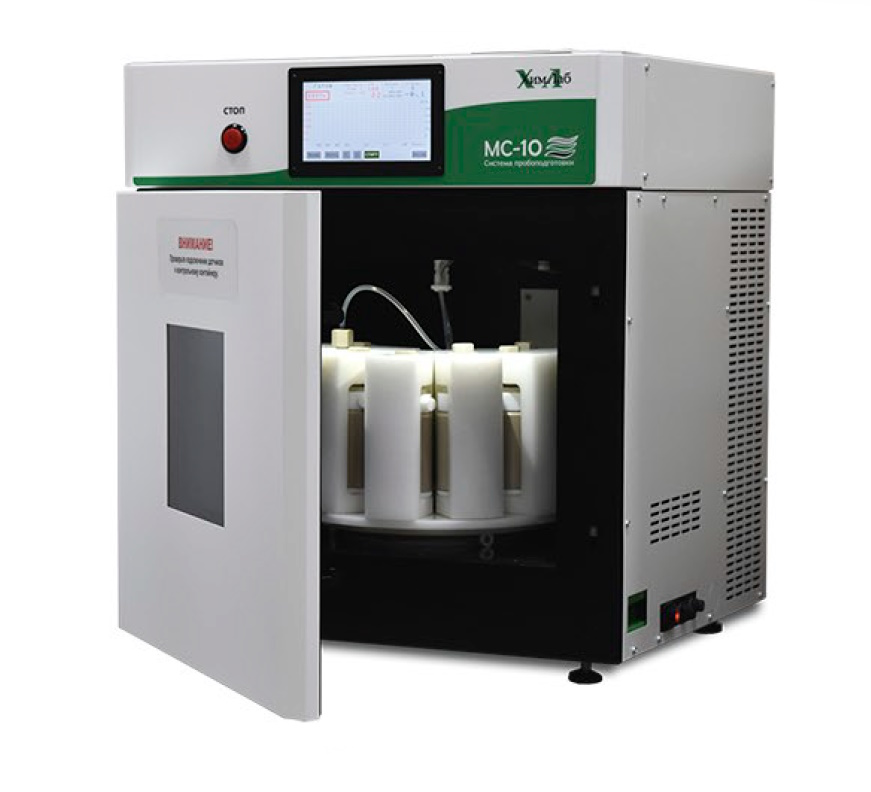
Microwave system MS-10
Microwave system MS-10 designed for decomposition (mineralization) of samples of food products, food raw materials, soils, rocks, environmental materials, biological fluids, inorganic materials, etc. when analyzing the chemical composition of samples using various methods: voltammetry, atomic absorption spectroscopy, spectrophotometry, etc. Also, the MS-10 microwave sample preparation system can be used in the microwave synthesis of various nanostructured compounds. The operating principle is based on the use of microwave energy for rapid volumetric heating of samples in sealed containers with oxidizing agents to destroy the organic and inorganic matrix that interferes with elemental analysis. Sample processing occurs at elevated pressures and temperatures. During the entire mineralization process, the pressure and temperature supplied to the magnetron are monitored in real time. The system is controlled using a touch panel located on the front panel of the case. Main features: touch display; intuitive interface and the ability to monitor the progress of the decomposition process in real time; stainless steel chamber; possibility of simultaneous setting of pressure and temperature; equipped with a segmented rotor HP (up to 10 containers) or a cylindrical rotor LP (up to 12 containers); an autonomous ventilation system, which allows the system to be placed outside a fume hood, and also speeds up the sample cooling process upon completion of preparation; the use of sealed containers eliminates the loss of volatile components (mercury, arsenic, selenium, etc.); an explosion-resistant door with a double protection system made of steel can withstand directed impacts; external protective covers on containers; lack of disposable safety membranes; Availability of ready-made sample preparation methods. Rotors and containers The LP rotor liners are made of PTFE-TFM material, while the HP rotor liners are made of TFM material. The liners can withstand high temperatures/pressures and prolonged exposure to acids. External casing made of reinforced PEEK material. The design of the containers allows for a quick process of assembling/disassembling the container. The containers are equipped with reusable safety diaphragms to safely relieve pressure in the event of an uncontrolled reaction. The ten- or twelve-position rotor is designed to accommodate 2, 4, 6, 8, 10 or 12 containers, respectively. The use of sealed containers eliminates the loss of volatile components (mercury, arsenic, selenium, etc.) Software Control is carried out using a built-in terminal with a color touch display and built-in software. Temperature and pressure data are displayed on the screen in graphical and digital form in real time and are stored in the non-volatile memory of the device. Graphic display of pressure and temperature values allows you to effectively select conditions when developing methods decomposition. An intuitive interface and ready-made pre-installed decomposition programs make it easier to work with the device and allow you to achieve excellent reproducibility of decomposition parameters. The user can create his own decomposition techniques. All parameters of the microwave sample preparation process are monitored in real time. Control and security systems Temperature and pressure in the reaction vessel are controlled using temperature and pressure sensors. Their feedback to the magnetron allows you to regulate the supplied power and ensures the most accurate reproduction of the specified sample decomposition conditions, as well as high operational safety. In addition to continuous monitoring and maintenance of the set temperature and pressure in the vessel, safety in an emergency is ensured by a number of additional systems, including an emergency magnetron shutdown device, a ventilation system and removal of reaction gases from the chamber, as well as an explosion-proof installation chamber with a special door lock. Standard algorithm programs with ready-made sample preparation methods: feed; fish bone tissue; agricultural products; biologically active additives (BAS); biological fluids; biomaterials (hair); organic samples (plastic, polypropylene); paper, cardboard, suede, cloth, wool; carbonated drinks; alcoholic drinks; natural juices; sauces, spices; inorganic samples (soils, bottom sediments, sand, plaque, ash, etc.); wood; confectionery, sweets; bread, bakery products; mineral raw materials; flour, yeast; drinking, natural and treated wastewater; vegetables, fruits, mushrooms, nuts, etc. Manba: https://www.nv-lab.ru/catalog_info.php?ID=7870
- Parameter: Value
- Working chamber volume, l: 53
- Maximum weight, g: 2
- Reagent consumption per sample, ml, no more than: 10
- Sample decomposition time, min: 10…30
- Dimensions (W × D × H), mm: 680 × 650 × 590
- Weight, kg, no more: 65
- Power consumption, W: 2000
- Power (voltage, V / frequency, Hz): 220 / 50
- Number of simultaneously processed samples, pcs.: 2; 4; 6; 8; 10; 12
- Liner (container) volume, ml: 100
- Liner (container) material: PTFE-TFM
- Working pressure, atm: up to 14
- Operating temperature, °C: up to 240
- Number of simultaneously processed samples, pcs.: 2; 4; 6; 8; 10
- Liner (container) volume, ml: 100
- Liner (container) material: TFM
- Working pressure, atm: up to 50
- Operating temperature, °C: up to 260