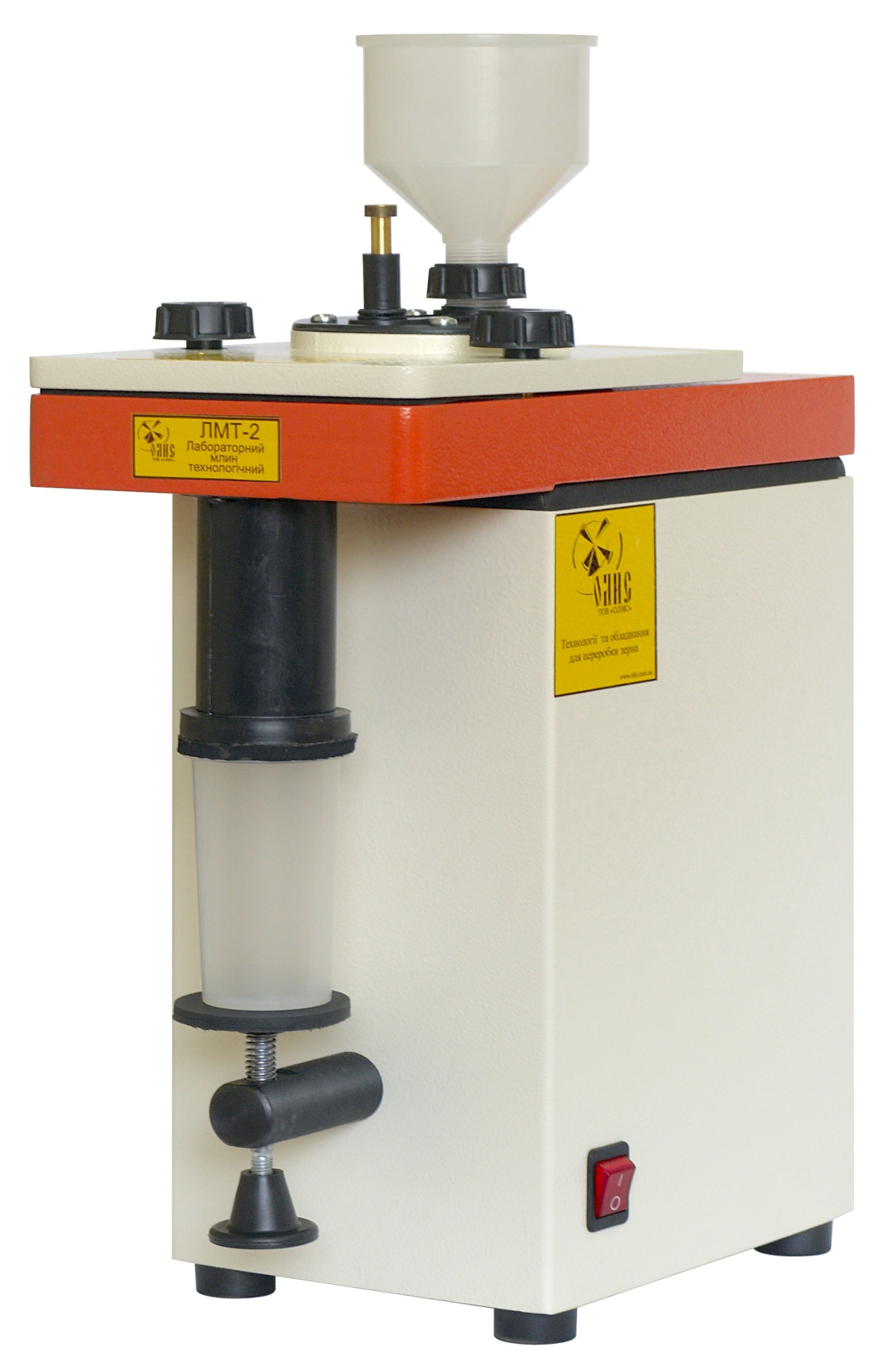
Laboratory mill LMT-2 technological
Laboratory mill LMT-2 LMT-2 is intended for grinding laboratory samples of grain of agricultural crops and products of their processing in order to prepare for subsequent determination of grain quality indicators. LMT-2 is used in PTL grain receiving, flour-grinding and grain processing enterprises, GHI laboratories, in the agricultural system, breeding and research organizations, independent laboratories and other organizations involved in assessing the quality of agricultural crops and their processed products. The mill is used to prepare samples to determine the quantity and quality of gluten, “falling number”, protein content, as well as other indicators, the determination of which requires grinding the product to a given size. The mill provides grinding of a sample of grain weighing from 10g to 100g with a given stable particle size. Sieve control of the crushed product is not required (passage of sieve No. 067 is no more than 1%, passage of sieve No. 38 is not less than 60%). The mill is equipped with replaceable calibrated sieves with a diameter of 0.8 and 1.0 mm. Description: The LMT-2 mill consists of a housing on which a plate with a cyclone is mounted. A lid is mounted on the stove, on which a receiving funnel is installed, as well as a valve. The cavity of the plate contains a shell made in the form of a ring with a notch on the inside and a sieve. There is an impeller in the cavity of the plate. An electric motor is installed inside the housing on a slide, driving the impeller through a V-belt drive. The initial product comes from the receiving funnel, is picked up by the flow and, through a groove with a hole in the lid, enters the cavity of the plate with the impeller. Under the action of the centrifugal force applied by the impeller, the product is thrown onto the shell, acquiring a circular motion. While moving along the surface of the notched shell, the product is crushed and its particles, together with air, are pumped through a sieve into the cyclone. After separation from the product, the air is forced through the cavity of the lid into the cavity of the plate, where it passes through filters for cleaning and is thrown out. The crushed product, separated from the air, enters a receiving container to collect the crushed product. Advantages of the laboratory mill LMT-2: · The presence of adjustable automatic dosing of the supplied product allows you to grind a product of high humidity. · The presence of self-cleaning devices for the dosing system, grinding chamber and product pipeline eliminates the mixing of the grinded sample with the remnants of the previous sample. · The drive belt is multilayer, reinforced with five layers of synthetic polyamide threads, practically does not stretch and does not require regular tensioning. · The special shape of the impeller prevents it from jamming when grinding large grains (peas, corn, soybeans). · The use of a special filter fabric ensures effective purification of the used air from dust and eliminates its release into the laboratory workspace. Specifications: Grain supply automatic adjustable with self-cleaning Weight of grinded product, g 10-100 Grinding time for a sample weighing 50 g, s 20-40 Permissible number of grindings per hour 30 Size of crushed product, no more than, mm 14 Loading hopper volume, ml 280 Receiving hopper volume, ml 250 Rotation speed of the grinding body, rpm 10200 Engine power, W 550 Power supply (single-phase network), V/Hz 220/50 Noise level, dB 73-75 Set of sieves, mm/mm 0.8; 1.0 Overall dimensions (without grain bin), mm 342x178x408 Weight, kg 17.5 Manba: https://www.nv-lab.ru/catalog_info.php?ID=1030