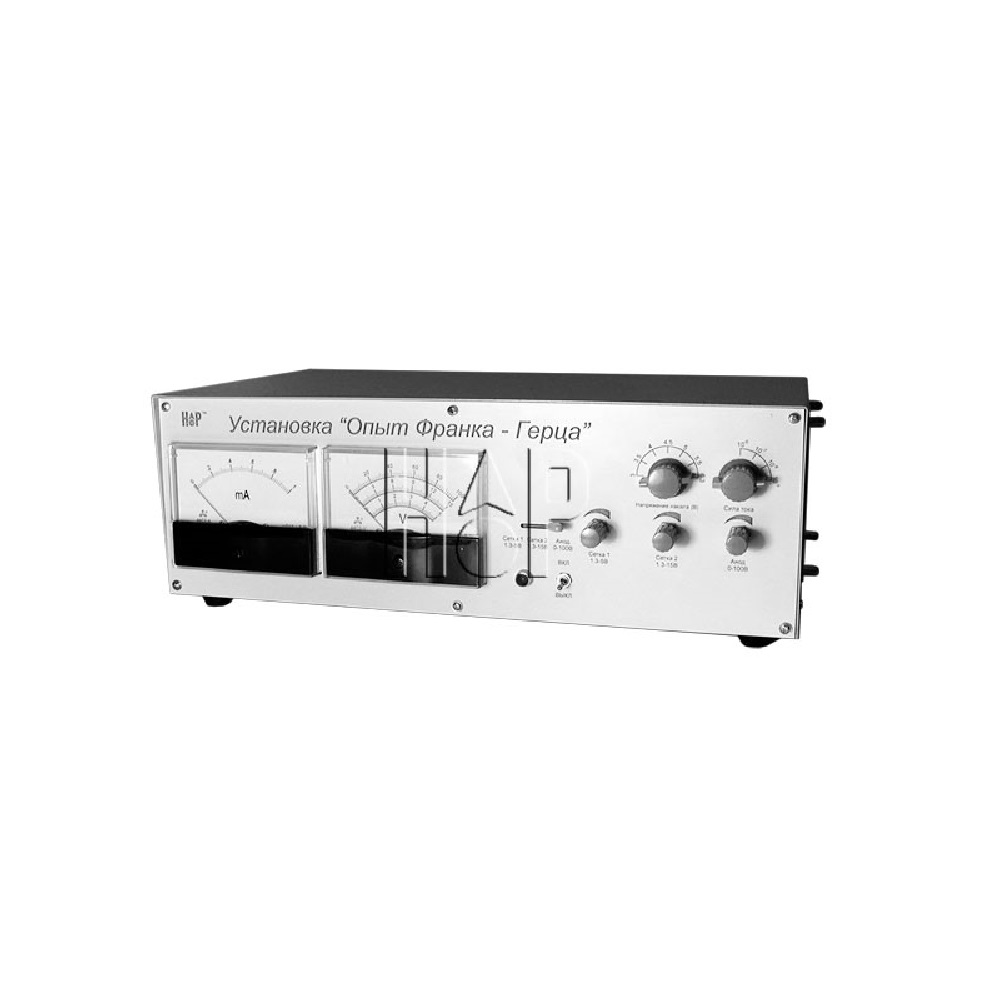
Laboratory installation "Frank-Hertz Experiment" Naurash
Naurash's "Frank-Hertz Experiment" installation is built on the basis of a four-electrode vacuum lamp filled with argon at low pressure. In addition to the lamp, the housing contains a circuit for its power supply and measuring circuits, including digital current and voltage sensors that allow you to control the accelerating voltage and collector current. The dependence of the collector current on the accelerating voltage is recorded on the computer screen with a smooth increase in the voltage supplied to the anode. When processing the resulting curve, the values of the accelerating voltage (electron energy), at which the collector current reaches maximum values, are read using a marker. The value of the argon excitation potential is calculated as the average value of the voltage difference between two adjacent maxima on the curve.
- Academic discipline: Physics
- Type: Laboratory unit
- Processing of experimental data: Via computer
- Country of origin: Russia
- Dimensions: 400x230x13 mm