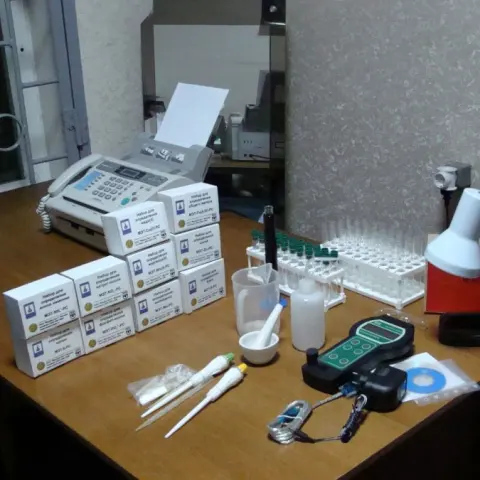
Laboratory of Plant Functional Diagnostics (FED)
Laboratory of functional diagnostics of plants designed to determine the needs of plants for macro- and microelements based on functional diagnostics using the photocolorimetric method of analysis METHOD FOR DETERMINING THE NEEDS OF PLANTS FOR MACRO AND MICROELEMENTS BASED ON FUNCTIONAL DIAGNOSTICS. Methods for diagnosing plant nutrition are divided into soil and plant based. Plant diagnostics, in turn, includes visual, chemical and functional. Visual diagnostics is the simplest method that does not require special equipment; it allows one to relatively quickly identify disturbances in mineral nutrition and eliminate their causes. However, to successfully perform visual diagnostics, in addition to knowledge, significant practical experience is required, since deficiencies and excesses of different elements often look very similar in appearance. In addition, often external signs of plant nutritional disturbances appear only when irreversible crop losses have already occurred due to these disturbances. Chemical diagnostics of mineral nutrition (tissue or leaf) allows us to determine the chemical composition of the plant at a given moment. Only with a constant supply of the necessary nutrients in optimal proportions throughout the entire growing season is it possible to maximize the use of the biological potential of each variety. However, sometimes a nutrient accumulates in a plant not because it is necessary for development. In addition, a deficiency or excess of one of the elements may interfere with the supply of another element to the plant. These factors limit the possibilities of using chemical diagnostic methods. Functional diagnostic methods make it possible to assess not the content of a particular nutrient, but the plant’s need for it. The need of plants for elements can be assessed by controlling the intensity of physiological and biochemical processes. A.S. Pleshkov and B.A. Yagodin (1982) developed a principle for diagnosing plant nutrition by determining the photochemical activity of chloroplasts. The principle of this method is as follows. The photochemical activity of a suspension of chloroplasts obtained from an average sample of leaves of diagnosed plants is determined, then a nutrient element is added to the suspension of chloroplasts in a certain concentration and the photochemical activity of the suspension is again determined. If the photochemical activity of a chloroplast suspension increases compared to the control (without adding elements), a conclusion is drawn about a deficiency of this element; if it decreases, it is an excess; if the activity is the same, the optimal concentration in the nutrient medium is reached. The method allows you to determine within 40-50 minutes the need of any plants for 12-15 macro- and micronutrients and give recommendations for root and foliar feeding, which is especially important when introducing new varieties and expanding the range of crops. This method can be used to diagnose the nutrition of plants grown both in soil and hydroponically The rapidity of the method allows, before each feeding of plants, to quantify the need for macro- and microelements and adjust the nutrition of plants in each field (down to an individual plant) for nitrogen, phosphorus, potassium, calcium, magnesium, boron, copper, zinc, iron, manganese, molybdenum, cobalt, iodine. This method has been used in more than 130 farms in Russia, Belarus and Ukraine, including in the Ivanovo region (“Teplichny”) since 1990, and in the Moscow region (“Belaya Dacha”) since 1992. The use of the method in production has shown its high efficiency. Basic package: photocolorimeter Ecotest-2020 (stitched for 1 wavelength); laboratory glassware; rack for 40 tubes; dispensers; a set of chemical reagents with a dye for 10,000 tests; packaging (plastic box on wheels); a guide to performing FED analyzes with calculation examples. Manba: https://www.nv-lab.ru/catalog_info.php?ID=1038