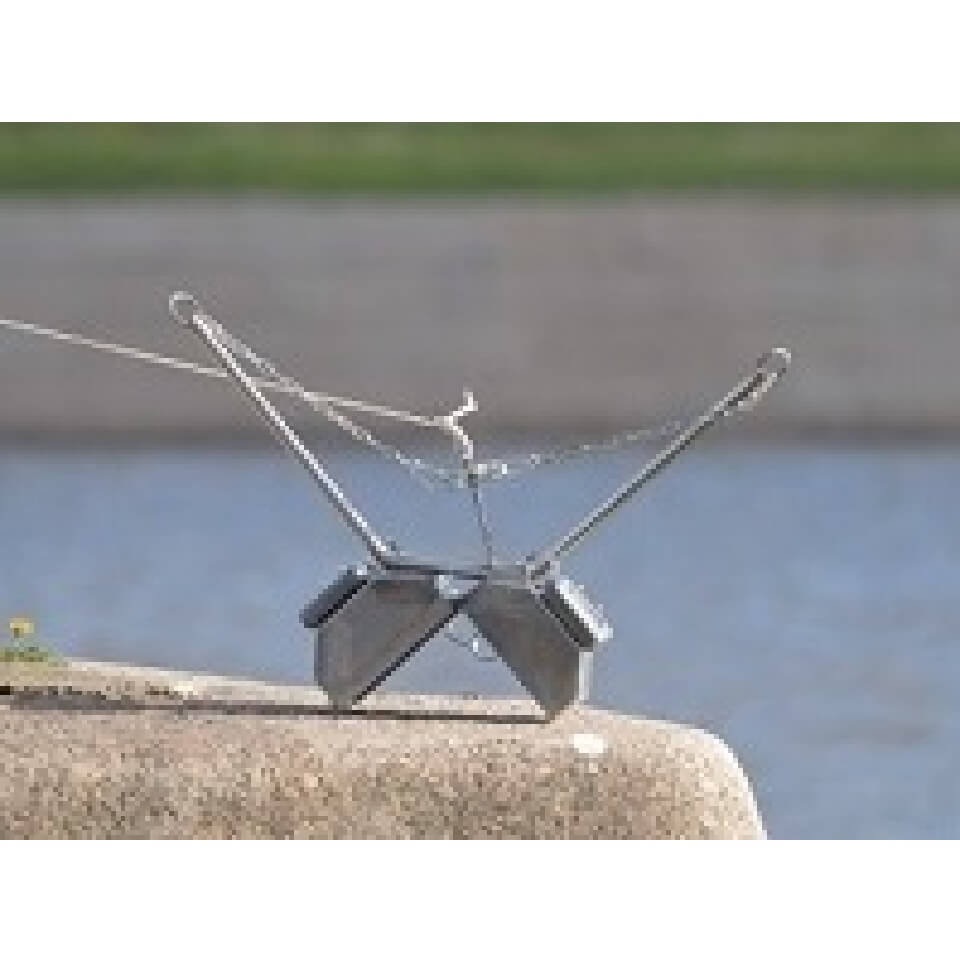
Van Veen's ladle
Van Veen's ladle Sampling is the first and one of the most important stages of chemical, microbiological and other types of analysis. The reliability of the results of subsequent measurements depends on its implementation. Errors resulting from incorrect sampling are almost impossible to correct in the future. As a result, further research, even using the most accurate and expensive equipment, may be pointless. That is why great attention is paid to correct sample selection. The most important factors influencing the correct sampling are the training of specialists performing sampling and the use of special equipment that makes sampling accurate, reproducible and eliminates contamination from the outside. The Van Veen bucket is designed for sampling the surface layer of bottom sediments. Description A bucket with open doors smoothly sinks to the bottom of the reservoir. Due to its own gravity and the moment of force applied to the sides of the bucket when closing it, it is pressed into the ground by the sides and cuts off the soil sample. After closing the valves, the soil sample is isolated from the aquatic environment, so the soil is not washed away when removed from the water. Holes on the surface of the bucket allow air to escape during a dive. A modification with lids on the doors (only for buckets with a volume of 15 and 30 l) allows sampling without opening the bucket and mixing the soil. Quick-release weights allow you to change the weight of the device, depending on the density of bottom sediments and the presence of currents. The device is successfully operated in departments of Roshydromet, TsLATI, water management agencies, laboratories of universities and research institutes. Manba: https://www.nv-lab.ru/catalog_info.php?ID=10175
- Parameter: Value
- Bucket volume, l: 2; 3; 6; 15; 30
- Capture area, m2: 0.025 (for buckets with a volume of 2 and 3 l);
- 0.05 (for a 6-liter bucket);
- 0.1 (for a 15 l bucket);
- 0.2 (for a 30 l bucket)
- Material: stainless steel
- Metal thickness, mm:
- - for buckets with a volume of 2, 3 and 6 l;
- - for a bucket with a volume of 15 l;
- - for a 30 l bucket: 2-3;
- 3-4;
- 4