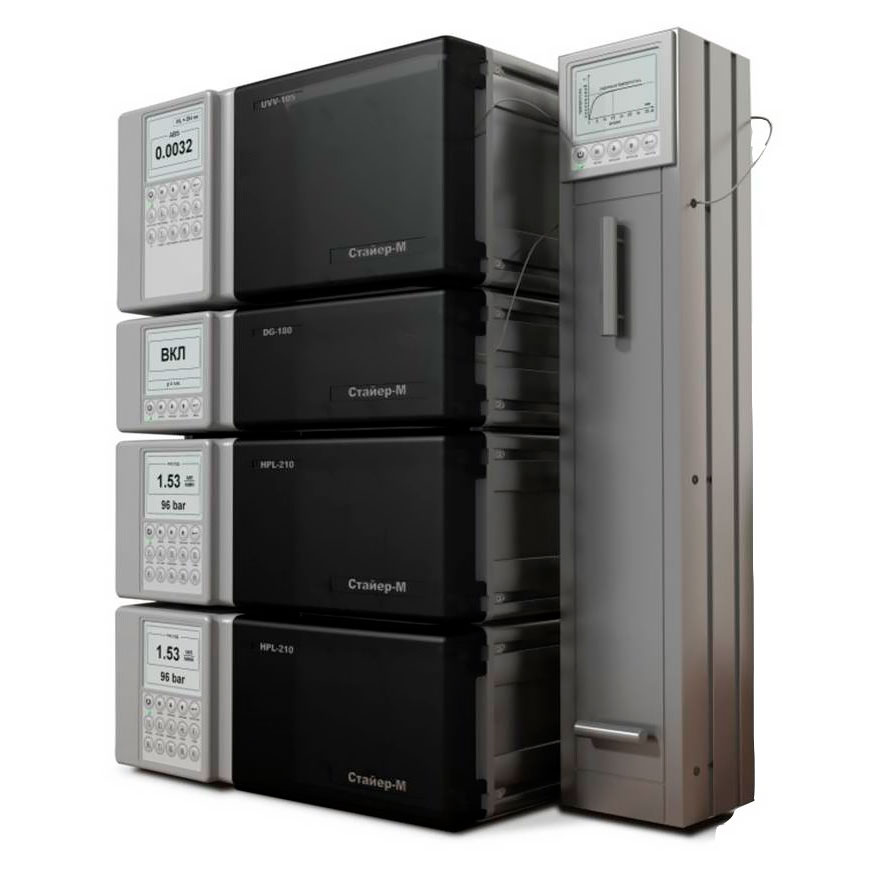
Liquid chromatograph Aquilon Stayer-M
Liquid chromatograph Stayer-M designed for qualitative and quantitative analysis of the content of a wide range of inorganic and organic substances in various objects, including the determination of microquantities of substances. Suitable for solving daily routine analytical tasks. It has the metrological characteristics necessary to guarantee compliance with the requirements of current regulatory documents, and at the same time it is in the budget price category and does not require the highest level of personnel qualifications. The separation of the analyzed sample in a chromatographic column can take place in isocratic or gradient modes. Subsequent measurement of the content of sample components is possible with a spectrophotometric, conductometric, fluorimetric, refractometric or amperometric detector, as well as a low-temperature evaporative light scattering detector. The block-modular principle of the chromatograph allows you to create an optimal configuration of the device depending on the tasks of the analytical laboratory. Housing The chromatograph has a design that eliminates the influence of metallic materials on the analysis results and ensures high corrosion resistance of the equipment. Manufactured in modular and monoblock versions. The housing can be mounted on a standard chromatography rack or installed as a separate unit. The front and rear panels of the housings are molded from chemically and mechanically resistant PBT plastic, reinforced with glass fiber and capable of withstanding long-term work in a chemical laboratory. The doors are molded from PMMA (polymethyl methacrylate). The load-bearing structural elements are made of aluminum using high-temperature extrusion and processed using the hard anodizing method. HPLC pumps The chromatograph can be equipped with different eluent supply systems. The Stayer-M line includes isocratic single- and double-head pumps in both metallic (SS 316) and non-metallic (PEEK) versions, designed for different flow ranges. To minimize the level of residual pulsations in each pump, an adaptive algorithm for reducing them is used, based on continuous monitoring of the pressure value and changing the angular speed of rotation of the stepper motor. By using this approach, it is possible to achieve minimal flow pulsations even for single-plunger pumps with a passive damper. All isocratic double-head pumps have active eluent degassers built into them. Gradient elution systems It is possible to equip the chromatograph with a gradient elution system with the formation of both low and high pressure gradients. All gradient elution systems have built-in active eluent degassing systems. Low pressure gradient formation systems are based on controlled and synchronized switching of solenoid valves on solvent supply lines, synchronized with the movement of the plunger. Thus, it is possible to form binary, ternary and quaternary gradients or work in isocratic systems containing up to four initial solvents. The formation of a high-pressure gradient is organized using an external dynamic mixer, which mixes the flows from the pumps in the active mixing mode using a miniature magnetic stirrer. Processor control of the stirrer rotation speed allows you to avoid interruptions in flow mixing and implement a controlled set of its rotation speed. The geometry of the mixer chamber allows for optimal mixing of flows in a wide range of pump flow rates. Various modifications of the mixer are designed to connect two or four high-pressure pumps. Detectors The range of available detectors largely determines the analytical capabilities of liquid chromatographs. The Stayer-M line of chromatographs includes a wide range of detectors: spectrophotometric, refractometric, fluorimetric and conductometric. It is also possible to equip it with a diode matrix, mass spectrometric or low-temperature evaporative light scattering detector. Conductometric detector CDD-520 is successfully used in both double-column and single-column versions of ion chromatography. To further stabilize the temperature, the eluate is thermostated at the entrance to the cell in a polymer capillary (0.25 mm ID) with a total dead volume (including cell volume) not exceeding 70 μL, which allows the instrument to be used for working with columns with an internal diameter of 2 mm. A specialized cell design with stainless steel electrodes prevents gas formation, thereby reducing detector noise. Fluorimetric detector DFL-203 Compact and reliable detector with LED fluorescence excitation. There is not a single moving part in the detector design, except for the mechanism for switching cut-off filters. The device is available with preinstalled 280/365 nm or 255/365 nm LEDs, which allows you to solve almost any analytical problem. The special design of the cuvette allows operation at pressures up to 30 bar with solvents with pH from 0 to 14. A low-noise photomultiplier provides increased sensitivity and improved signal-to-noise ratio. The maximum flow rate through the cuvette is 10 ml/min. Detectable volume – 10 µl. Spectrophotometric detector UVV-105 The spectrophotometric detector UVV-105 is designed both for routine analyzes and for the implementation of rather complex analytical tasks, including microscale and preparative chromatography. It can be controlled both from the instrument panel and through external interfaces. Operates in the wavelength range 190-600 nm without changing the lamp. Deuterium lamp with a guaranteed service life of at least 1000 hours. Refractometric detector REF-105 The REF-105 detector differs from its analogues by a three-chamber cell of an original design that does not require GOC technology (deep optical contact, DOP). This cell not only provides passive optical temperature compensation, which eliminates temperature control in most cases, but also makes it possible to work with liquid flows of up to 10 ml/min at pressures of up to 30 bar. Solvents with a pH of 0 - 14 can be used. Electronic zero adjustment when changing the eluent, no need for mechanical adjustment. Speaker thermostats For the Stayer-M line, monoblock column thermostats have been developed with a real accuracy of maintaining a temperature of no worse than 0.1 °C at a point and no worse than 0.2 °C throughout the entire volume of the column. The design of the thermostat provides not only heating, but also forced cooling of the speakers at high speed. The thermostat housing does not heat up during operation, which ensures comfortable working conditions for personnel and surrounding equipment. The temperature setting accuracy is no more than 0.1 °C. Possibility to install at least two columns in a thermostat complete with pre-column holders. Operation in temperature gradient mode. Accelerated response to changes in external conditions and quick return to operating mode. Suppressors of background electrical conductivity of the eluent Chemical and electrochemical suppressors of background electrical conductivity of eluents for ion chromatography provide a dramatic increase in the sensitivity of the method. An inexpensive chemical suppressor shows good results in separating anions, but requires regular changes of the suppression solution. The electrochemical suppressor, while maintaining a reasonable price, makes it possible to determine anions in minimal concentrations, while the special design of replaceable cartridges ensures a long service life. Eluent generators The flow-through ion chromatography eluent generator eliminates the need for users to prepare precise base solutions. The eluent is generated from pure water online on the high-pressure side by an electrochemical method, which allows not only to increase the stability and reproducibility of analysis results, but also to use gradient techniques. Flow and concentration control unit The use of a software-controlled concentration unit allows you to dramatically increase the sensitivity of almost any chromatographic method due to the introduction of a large sample volume. In this case, the analytes accumulate in a special concentrating column, from which, when switching the taps, they are washed out with an eluent with minimal broadening of the chromatographic peak. Power supply Jumps, dips, increased or decreased value of the mains voltage greatly affect the operation of any analytical equipment. In old buildings, there are sometimes problems with grounding and grounding, up to the appearance of voltage on the ground bus. To ensure operation in the most severe conditions, the design of Stayer-M units uses special power supplies that operate stably in the range from 110 to 250 V and can withstand quite serious voltage surges. Special measures taken in the development of electronic circuits allow Stayer-M chromatographs to operate even in networks with poor or no grounding. Software The chromatographs have access to an external IBM-compatible PC via the RS232 interface. Control of chromatograph modes and data processing is carried out from a personal computer using appropriate software. All blocks of the Stayer-M chromatograph communicate with each other using the Akvilon BUS bus, built on the basis of the modern industrial CAN protocol. All blocks “know” about each other’s existence and “understand” the processes occurring in neighboring blocks. Thus, connecting any subsequent block is reduced to its physical installation in the system and connection to any of the blocks already in the device with a bus connector. The chromatograph is connected to the computer via the RS-232C bus, and you can connect to any of the units installed in the system. The system configuration and operating parameters of the units are automatically transferred to the computer software. Stayer-M assumes the possibility of easy modernization and expansion of the device’s equipment with an expansion or change in the list of analytical tasks to be solved. The use of self-configuring mechanisms and the special design of the device make it possible to integrate new modules and change the system even for users with average qualifications. The Stayer-M units have the ability to update the firmware. Every chromatograph comes with Aquilon Control Center software, which allows users to install firmware updates themselves. Each time the device is turned on, a self-testing procedure for each unit is automatically and invisible to the user, based on which a testing protocol is generated. The resulting protocol contains not only the test data visible to the user in the device menu, but also the “deep” processes occurring in each block at the internal software level. This protocol in the form of a file can be sent to the service department via email and processed by specialized service programs, which in some cases allows you to quickly understand the problem and issue appropriate recommendations without a service engineer visiting. A special feature of the Stayer-M line is the ability of the built-in software to track actions performed on the device, which allows you to avoid breakdowns due to accidental operator errors, even when computer control is disabled or absent. Manba: https://www.nv-lab.ru/catalog_info.php?ID=2489
- Value: Parameter
- Zero signal fluctuation noise level, µS/cm: 6×10⁻¹
- Zero signal drift, µS/cm/h: 20
- Detection limit, g chloride ions sodium ions: 5×10⁻⁹ 2×10⁻⁸
- Relative standard deviation of the output signal, % area of peaks, heights of retention time peaks: 3 3 0.6
- Relative change in the value of the output signal, % for 8 hours of continuous operation: 3
- Dimensions, no more, mm: 165×320×320
- Weight, no more, kg: 4.2
- Zero signal fluctuation noise level, e.o.p.: 1×10⁻⁴
- Zero signal drift, e.o.p./h: 1×10⁻³
- Detection limit (phenol), g: 6×10⁻¹⁰
- Relative standard deviation of the output signal, % area of peaks, heights of retention time peaks: 4 4 0.5
- Relative change in the value of the output signal, % for 8 hours of continuous operation: 4
- Dimensions, no more, mm: 210×320×320
- Weight, no more, kg: 12
- Level of fluctuation noise of the zero signal, rel.un. fluor./h: 4×10⁻²
- Zero signal drift, rel. units fluor./h: 1.5×10⁻¹
- Detection limit (anthracene), g: 1×10⁻⁷
- Relative standard deviation of the output signal, % area of peaks, heights of retention time peaks: 4 4 0.5
- Relative change in the value of the output signal, % for 8 hours of continuous operation: 4
- Dimensions, no more, mm: 65×320×1320
- Weight, no more, kg: 7
- Zero signal fluctuation noise level, nA: 0.6
- Zero signal drift, nA: 15
- Detection limit (phenol), g: 1×10⁻⁹
- Relative standard deviation of the output signal, % area of peaks, heights of retention time peaks: 4 5 1.0
- Relative change in the value of the output signal, % for 8 hours of continuous operation: 12
- Dimensions, no more, mm: 165×320×320
- Weight, no more, kg: 5
- Zero signal fluctuation noise level, units. ref.: 4×10⁻⁶
- Zero signal drift, units ref./h: 5×10⁻⁴
- Detection limit (glucose), g: 1×10⁻⁵
- Relative standard deviation of the output signal, % area of peaks, heights of retention time peaks: 4 4 0.5
- Relative change in the value of the output signal, % for 8 hours of continuous operation: 4
- Dimensions, no more, mm: 117×265×320
- Weight, no more, kg: 12
- Zero signal fluctuation noise level, V: 4×10⁻³
- Zero signal drift, V/hour: 8×10⁻⁹
- Detection limit (glucose), g: 2×10⁻⁸
- Relative standard deviation of the output signal, % area of peaks, heights of retention time peaks: 5 6 0.5
- Relative change in the value of the output signal, % for 8 hours of continuous operation: 5
- Dimensions, no more, mm: 250×480×550
- Weight, no more, kg: 20