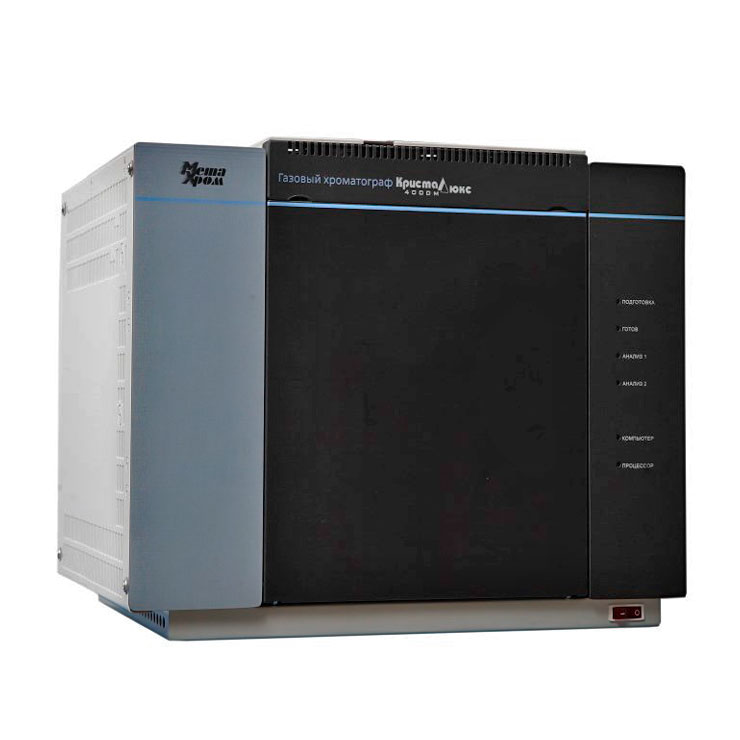
Gas chromatograph Meta-Chrome Crystallux-4000M
Gas chromatograph Kristalluks-4000M fully automated, from sample injection to processing of chromatographic information. The temperature of thermostats, flow and pressure of carrier gas, auxiliary gases, ignition of detectors, control of flame combustion during operation, and measurement of detector signals are automatically adjusted. The chromatograph is an analytical unit in the form of a monoblock with a medium or large column thermostat, on which an analytical module with detectors, injectors, dosing devices, and chromatographic columns is installed. The analytical unit has up to three independent channels for separating and processing information and consists of a column thermostat, a replaceable analytical module and an electronic gas flow control unit (ECCG). By individual order it is possible to install four detectors. To start the analysis, each channel has a “Start” button, which is duplicated as a software button. Chromatographs are available in two versions: Version 1 with a column thermostat volume of 6 liters. Version 2 with a speaker thermostat volume of 14 liters. Thermostats allow you to place up to four packed (metal or glass) or three capillary columns. The thermostat is controlled using a new high-precision temperature control algorithm, which makes it possible to increase the accuracy of temperature maintenance. The top panel of the thermostat (analytical module) can be fixed in the working or inclined position (at an angle of 35° in version 1 and 12° in version 2). On the top panel there is a cover designed to provide access to the gas circuit for its reconnection. To operate the thermostat in the area of negative temperatures, one of two cryostatic devices can be connected to the thermostat (using a refrigerant - liquid nitrogen - in which a lower temperature limit of −100 °C is achieved, or without using a refrigerant with cooling to −15 °C). Simultaneous analysis on two capillary columns with independent control of carrier gas flows is possible. It is possible to divide the flow after the capillary column into two detectors and introduce the sample simultaneously into two columns. It is possible to use two carrier gases, as well as switch them. The EUPG unit can control from 2 to 7 flows (including hydrogen and air) using electronic gas flow and pressure regulators. The chromatograph can regulate the pressure that controls the flow rate of the carrier gas through the capillary column. The sample is discharged from the capillary injector (split, split-splitless modes) using an electronic gas flow regulator and a trap, which also serves as a pressure buffer for the evaporated sample. The buffer is automatically cut off when the device is turned off using a reset valve. It is possible to maintain the optimal gas mode of the capillary column by programming the carrier gas flow by pressure, linear velocity or mass flow. There is a gas saving mode and a “sleep” mode for the chromatograph. The chromatograph can be equipped with a wide range of detectors, both single and combined into a multi-detector (up to three detectors, both universal and selective). Detectors for chromatograph Kristallux-4000M: Flame ionization detector (FID). Thermal conductivity detector (TCD). Electron Capture Detector (ECD) Flame photometric detector (FPD). Thermionic detector (TID). Photoionization detector (PID). Thermochemical detector (TCD). Helium ionization detector (HID). Mass spectrometric detector (MSD) or combinations thereof. Replacement modules of the Kristallyuks-4000M chromatograph There are standard replaceable analytical modules that can be easily installed on the column thermostat and changed if necessary. The replaceable module contains a set of detectors (multidetector), injectors (two or three injectors that transform from capillary to nozzle by installing special adapters) and additional devices. You can also create your own replacement module with the necessary detectors in almost any combination. Possible standard options: Module 2 PID. Road accident module (RTA/RTA). PID/DTP module (DTP/DTP/PID). ECD/TID module (PID/EDD/TID). PID module (PID/EDM, PID/PID). PID/ECD/PDF (PID/PDF) module. Software To operate, you need a personal computer on which the NetChrom software for processing chromatographic information and, if necessary, chromatographic analysis techniques are installed. The software included in the chromatograph runs in Windows and Linux environments. It allows you to set and control the operating parameters of the chromatograph, monitor the analysis, and process experimental data. The software uses the following protection methods: protection against unauthorized distribution with an electronic key, protection against unauthorized use by delineating user access rights, protection against hardware and software errors using an event log, protection against the introduction of knowingly incorrect data, protection of the integrity and authenticity of the software (hash code algorithms). The software protection level is “High” in accordance with R 50.2.077-2014. Additionally, non-standard programs are available: calculation of the calorific characteristics of natural gas, diagnostics of transformer oil, calculation of Shewhart control charts, identification of multicomponent mixtures (for example, vegetable oil, cognac, hydrocarbon fuel, etc.), data output to an external monitor. One computer can work in real time with several analytical units (up to eight). It is possible to connect and work with chromatographs of other brands via NetChrom software. Information exchange between the computer, analytical units and the chromatograph is carried out via standard interfaces such as RS-232C, USB, Ethernet. Remote control of the chromatograph is possible (via the Internet). If it is not possible to connect the chromatograph to a computer, you can purchase a remote control panel. Additional equipment For ease of operation, the chromatograph can be equipped with additional equipment and components. Automatic liquid sample dispenser type NTZOOOA. A distinctive feature of the autosampler: the ability to introduce a sample alternately into both evaporators, sample injection with an internal standard, a free evaporator for manual input. Automatic equilibrium steam sample dispenser type NT2000N. Combined automatic dispenser HT2800T (liquid, equilibrium steam, SPME). Gas metering valves from 4 to 12 ways, including automatic and thermostatically controlled, operating temperature of the valves up to 180 °C. Backflow valves, including automatic ones. Liquefied gas dispenser, including automatic and cooled to −5 °C. Automatic device for switching capillary columns using Dean elements. Pyrolyzer. Methanator for analysis of CO, CO. Column thermostat cooling device, incl. without the use of refrigerant. Thermal desorber with the ability to introduce solid samples. Equilibrium steam dispenser. Filter for catalytic purification of gases (nitrogen from oxygen, air from hydrocarbons), either separately or in one housing. A device for achieving equilibrium in transformer oil. Devices for cryoconcentration. Generators of nitrogen, hydrogen, air. Gas panel. Application of the Kristallyuks-4000M chromatograph: Analysis of the composition and quality of natural, associated, liquefied gases, gas condensate, with calculation of calorific value, relative and absolute density, saturated vapor pressure. Analysis of the detailed and group composition of motor fuel, including gasoline, with calculation of octane number, density, fractional composition, saturated vapor pressure. Analysis of motor fuel for the content of aromatic and oxygen-containing compounds, MMA, etc. Analysis of oil, motor fuel and gas for the content of hydrogen sulfide, mercaptans, sulfides, thiophenes and other sulfur compounds. Analysis of chemical and petrochemical products. Analysis of transformer oil for the content of dissolved gases, moisture, total gas content, antioxidant additives, furan derivatives, PCBs, SF6 gas analysis. Analysis of toxic impurities in alcoholic beverages, perfumes, and medicines. Analysis of the authenticity of alcoholic beverages, incl. cognacs Analysis of wine and wine materials for the content of ethanol, organic acids, etc. Analysis of water for the content of volatile halogen-containing and aromatic compounds, acetone, methanol, saturated hydrocarbons, petroleum products, etc. Analysis of pesticides, herbicides and other toxicants in water, soil, crop products and food. Analysis of atmospheric air for the content of halogen-containing and aromatic hydrocarbons, carbon oxides, etc. Analysis of industrial emissions and work area air for the content of saturated, unsaturated and aromatic hydrocarbons, carbon oxides, etc. Analysis of the toxicity of food packaging, construction and other household materials, incl. toys. Analysis of mine air for the content of permanent gases, carbon oxides and hydrocarbons. Analysis of the quality of vegetable and animal oil, margarines, spreads, dairy products, detection of falsifications. Analysis of biological fluids and tissues of the human body for the content of alcohol, narcotic, medicinal and toxic substances. Analysis of gaseous environments of nuclear power plants. Analysis of blast furnace products, quality of gases used in metallurgy. Analysis of impurities in helium, oxygen, nitrogen, argon by cryogenic concentration method. Analysis of oil and chemical reagents for its production for the content of volatile organochlorine compounds. Analysis of paint and varnish production products. Analysis of the quality of tobacco products. Analysis of propellants, aerosols, refrigerants. Analysis of adsorbed gases in soil for oil and gas exploration. Manba: https://www.nv-lab.ru/catalog_info.php?ID=1786
- Parameter name: Version 1
- FID detection limit: 2×10-12 gS/s for n-hydrocarbons 1.4×10⁻¹² gS/s for propane
- Road accident detection limit: 1×10⁻⁹ g/ml for n-hydrocarbons
- ECD detection limit: 2×10-14 g/s for lindane
- FPD detection limit: 1×10-13 gS/s by metaphos 1×10-12 gS/s by metaphos
- TID detection limit: 2×10-14 gN/s for metaphos 3×10-13 gN/s for azobenzene
- TCD detection limit: 5×10⁻¹⁰ g/ml for hydrogen
- PID detection limit: 5×10-13 g/s for benzene
- HID detection limit: 3×10-13 g/s for carbon in methane
- MSD signal-to-noise ratio: 50:1 when injecting 1×10-12 g/µl octafluoronaphthalene in isooctane
- Linear PID dynamic range: 1×10⁷
- Linear dynamic range of accident: 1×10⁶
- Column thermostat volume: 7 (10) l
- Column temperature: From Tamb. environment +4 °C to +400 °C On special order up to 450 °C From −15 °C using refrigeration. installations From −100 °C using liquid nitrogen
- Temperature setting resolution: 0.1 °C
- Temperature stability: 0.01 °C
- Temperature programming speed: 0.1 to 120 °C/min
- Number of isotherms: at least 30
- Column oven cooling rate from 400 to 50 °C: 8 min
- Maximum detector and evaporator temperature: 450 °C
- Carrier gas flow: from 0 to 100 ml/min (up to 500 ml/min on special order)
- Carrier gas pressure (for capillary column): from 0 to 0.40 MPa (up to 1 MPa on special order)
- Maximum gas inlet pressure on special order: 0.5 MPa 1.25 MPa
- Hydrogen flow Air flow: 0-500 ml/min 0-1000 ml/min